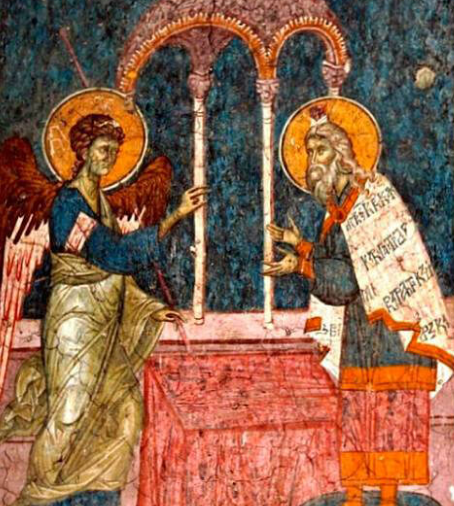
Luke 1:5-25
This essay follows the order of Aland’s Synopsis of the Four Gospels and uses the NASB 2020 translation. It focuses on Luke 1:5-25, the account of Zechariah’s encounter with the angel Gabriel in the Jerusalem temple.
Drawing on Old Testament themes such as prenatal consecrations, a barren matriarch, and Malachi’s prophecy of Elijah’s return, the account presents John as the consecrated forerunner who will “prepare the way” for the Messiah. This story opens Luke’s Infancy Narratives, the birth accounts that begin his Gospel. Raymond Brown’s The Birth of the Messiah remains the primary critical study of this material, including Matthew’s parallel infancy account. Specifically, Luke uniquely tells the story of John’s conception and birth, while Mark starts with John already an adult at the Jordan, just before baptizing Jesus.
This essay argues that Zechariah and Elizabeth cannot be read apart from the Old Testament and that Luke’s interest in them is primarily symbolic rather than biographical: nearly every detail he selects presents their son as the consecrated forerunner, set apart before birth to prepare a people for the Lord.
Luke 1:5-25, The Birth of John the Baptist Foretold
5 In the days of Herod, king of Judea, there was a priest named Zechariah, of the division of Abijah. He had a wife from the daughters of Aaron, and her name was Elizabeth. 6 They were both righteous in the sight of God, walking blamelessly in all the commandments and requirements of the Lord. 7 And yet they had no child, because Elizabeth was infertile, and they were both advanced in years.
8 Now it happened that while he was performing his priestly service before God in the appointed order of his division, 9 according to the custom of the priestly office, he was chosen by lot to enter the temple of the Lord and burn incense. 10 And the whole multitude of the people were in prayer outside at the hour of the incense offering. 11 Now an angel of the Lord appeared to him, standing to the right of the altar of incense. 12 Zechariah was troubled when he saw the angel, and fear gripped him. 13 But the angel said to him, “Do not be afraid, Zechariah, for your prayer has been heard, and your wife Elizabeth will bear you a son, and you shall name him John. 14 You will have joy and gladness, and many will rejoice over his birth. 15 For he will be great in the sight of the Lord; and he will drink no wine or liquor, and he will be filled with the Holy Spirit while still in his mother’s womb. 16 And he will turn many of the sons of Israel back to the Lord their God. 17 And it is he who will go as a forerunner before Him in the spirit and power of Elijah, to turn the hearts of fathers back to their children, and the disobedient to the attitude of the righteous, to make ready a people prepared for the Lord.”
18 Zechariah said to the angel, “How will I know this? For I am an old man, and my wife is advanced in her years.” 19 The angel answered and said to him, “I am Gabriel, who stands in the presence of God, and I was sent to speak to you and to bring you this good news. 20 And behold, you will be silent and unable to speak until the day when these things take place, because you did not believe my words, which will be fulfilled at their proper time.”
21 And meanwhile the people were waiting for Zechariah, and were wondering at his delay in the temple. 22 But when he came out, he was unable to speak to them; and they realized that he had seen a vision in the temple, and he repeatedly made signs to them, and remained speechless. 23 When the days of his priestly service were concluded, he went back home.
24 Now after these days his wife Elizabeth became pregnant, and she kept herself in seclusion for five months, saying, 25 “This is the way the Lord has dealt with me in the days when He looked with favor upon me, to take away my disgrace among people.”
Point 1: Who Were Zechariah and Elizabeth?
Luke opens the story of Zechariah and Gabriel with a classic prophetic introduction. Luke 1:5 states, “In the days of Herod, king of Judea…,” tying the message to a specific ruler, a common pattern in the Old Testament (see Isaiah 1:1, Jeremiah 1:2, Hosea 1:1, Amos 1:1). This beginning sets the historical scene and hints at the genre, suggesting that prophetic activity has restarted after a period of silence.
Aside from Luke’s account, there is no direct evidence that Zechariah and Elizabeth were real historical figures. However, the institutional background involving them is well documented. The twenty-four courses are mentioned in 1 Chronicles 24 and in the Mishmarot calendars from Qumran.[1] Josephus assigns his family’s own course to the order of Jehoiarib (Josephus, Life 1.2).[2] Still, verifiable settings and details do not prove that Zechariah and Elizabeth were real people.
Luke proposes that they are descendants of Aaron, but no external evidence confirms this. The absence of external or secondary sources is not a significant issue, given that Luke is the only source for many minor figures mentioned solely in his Gospel or Acts.
Since Zechariah and Elizabeth’s historical existence is uncertain, this essay analyzes the details Luke provides to interpret their symbolic significance. Luke highlights certain details that, whether or not they are factually accurate, serve to link John and Jesus to Jewish prophecies, which early Christians regarded as grounded in Scripture.
Although it might seem natural to link Luke’s Zechariah with the minor prophet Zechariah of the Old Testament, the more compelling connection is with 2 Chronicles 24:20-22. This passage details the story of Zechariah, son of Jehoiada, who was murdered in the temple courtyard. Jesus also mentions Zechariah, alongside other prophets, who were killed, in Luke 11:51.
This mention of Zechariah, the murdered priest, is a deliberate allusion by Luke. He opens his Gospel with a priest named Zechariah serving in the temple and then uses that priest’s namesake to condemn “this generation” for the “blood of all the prophets, shed since the foundation of the world.”
Elizabeth’s lineage and her name carry symbolic weight. Aaron’s wife was Elisheba, daughter of Amminadab (Exodus 6:23), and the Septuagint calls her Elisabet, the name Luke uses for Zechariah’s wife. Luke begins his Gospel with a priest from Aaron’s line, married to a woman “from the daughters of Aaron,” who shares the name of Aaron’s wife. While individual names like Zechariah and Elizabeth were common in first-century Judea, their pairing is more significant, echoing Israel’s original priestly couple and emphasizing symbolic continuity.
Since Zechariah is a priest and Elizabeth is a daughter of Aaron (Luke 1:5), John inherits Aaron’s lineage from both parents. He embodies Israel’s priestly legacy in his very lineage, which makes it all the more striking that Luke has him leave the temple system for the wilderness.
Another connection links Aaron and Moses to John and Jesus. Aaron, Moses’s elder brother, was the older yet secondary leader as the Israelites went from Egypt through the wilderness to the Promised Land. In the same way, John is the elder but subordinate figure to Jesus, as He guides God’s new Chosen toward salvation. By linking John to Aaron through both parents, Luke emphasizes John’s secondary, Aaron-like role rather than portraying him as a new Moses.
Point 1a: The Abijah Division
It is not clear why Luke thinks it is important to tell his readers that Zechariah served in the division of Abijah. Luke is a selective narrator who rarely spends words without purpose. It is unlikely he would linger on a meaningless detail about a minor character like John’s father. Whatever reason Luke had for including this detail is now lost. A few possibilities are worth weighing.
Luke emphasizes that Zechariah was “a priest… of the division of Abijah.” The number eight often has symbolic significance, prompting us to consider whether the eighth course holds special meaning. Luke names the division of Abijah, which 1 Chronicles 24:10 lists as the eighth of the twenty-four priestly courses. Additionally, Josephus confirms this division into twenty-four courses (Antiquities 7.365-367), showing that Luke’s count is supported outside the biblical text.[3]
Luke does use the number eight elsewhere, at the circumcision of both John and Jesus (Luke 1:59; 2:21; cf. Leviticus 12:3) and in his singular dating of the Transfiguration to “about eight days later” where Mark and Matthew have six (Luke 9:28; cf. Mark 9:2; Matthew 17:1). But those are counts of days, not courses, and Luke never ties them to Abijah’s rotation. The later Christian link between the eighth day and the resurrection is a second-century development Luke would not have known. The eighth course and the eighth day are separate threads, and nothing in the text joins them.
The names in this story could be invented for their theological effect. Abijah translates to “my Father is God,” Zechariah means “the Lord remembers,” and Elizabeth signifies “my God is an oath.” When read together, they form a kind of benediction. That is unremarkable, since most Jewish names express joy or reverence toward God. Luke provides no clue that he intended for the story’s names to be read that way. While the names may be there for their meaning, that is something that has to be read onto the text and is not something Luke asserts.
Another possibility is that Luke’s community had a particular date in mind for Jesus’s birth. If Mary conceived during the sixth month of Elizabeth’s pregnancy, a careful writer could trace backward to find John’s conception date. From there, it is straightforward to identify which priestly division was serving at the temple just before that time.
Luke’s Gospel does not specify Jesus’s birth date. While priests of Abijah served twice a year, Luke does not indicate which service he references. These variables leave several candidate dates open, yet scholars have still tried to fix one using the Qumran priestly-course calendar.[4] If Luke intended to highlight Jesus’s birth date, that detail has not survived to us.
A final possibility is that Luke added the detail to lend realism to the priest’s story. That explanation, though, does not say why he chose Abijah over any other course. There might have been a historical link between John and the Abijah order, which is no longer obvious today, and Luke’s account only hints at this connection. Either way, this is where the symbolic reading stops. Not every detail Luke selects carries Old Testament weight, and the priestly course most likely roots the story in a recognizable historical setting rather than encoding a hidden meaning.
Point 2: Zechariah and Gabriel in the Temple
In the Old Testament, incense smoke symbolized the people’s prayers to God (cf. Psalm 141:2), a symbol carried forward in early Christian imagination (Revelation 5:8; 8:3-4). Luke notes that “the whole multitude of the people were in prayer outside” at the hour of incense. When Gabriel then says, “your prayer has been heard,” the statement may carry a dual meaning, answering both Zechariah’s prayer for a child and those of the gathered worshipers, rising with the incense smoke.
The reading is not seamless. Luke’s phrase “your prayer” is singular and clearly a remark from Gabriel to Zechariah. The context suggests the broader reference: Luke has just positioned the praying crowd in the scene, and the son to be born is characterized mainly by his future actions for them (Luke 1:16-17).
What the crowd is asking for is not explicitly stated. Nevertheless, Gabriel has come to deliver what they need. Gabriel explains that Zechariah’s son will guide many Israelites back to the Lord and prepare a people, a promise of national restoration (Luke 1:16-17).
The scene shows that God’s will, not personal choice, determines events. Zechariah does not volunteer for the altar; instead, he is chosen by lot, a procedure that removes human preference. The outcome is therefore read not as accident but as God’s own choice (Proverbs 16:33; Leviticus 16:8; Acts 1:26). Consequently, the priest present at the altar when the angel appears is the one appointed by God. The people pray; God chooses the priest to convey their prayer; and through this priest, God responds to the people.
Luke says that “fear gripped him” (Luke 1:12); the Greek phrase means “having seen him, fear fell upon him.” This pattern appears again in Acts 19:17 and reflects a broader Lukan motif where divine encounters evoke fear. Similar instances occur in Luke 1:65, 2:9, and Acts 2:43. This fear indicates awe and reverence rather than terror.[5] This encounter marks the beginning of God’s reply to the people’s prayers for deliverance. This proclamation is not of the Messiah directly, but through His forerunner, who must come before Him as prophesied in Isaiah 40:3 and Malachi 3:1.
Point 3: Consecrated Before Birth
Gabriel tells Zechariah that his son John will drink no wine or liquor and will be filled with the Holy Spirit. Gabriel’s words cast John in Nazirite terms, though Luke records only the abstention from wine and strong drink (Luke 1:15), not the other marks of the vow, such as uncut hair and avoidance of corpse impurity. This Nazirite framing can be confusing, since Jesus was from Nazareth and was called a Nazarene. Yet the two terms are etymologically distinct: Nazirite derives from the Hebrew nazir (“consecrated”), while Nazarene derives from the place-name Nazareth. The label matters less than the timing. What Gabriel announces is a consecration fixed before conception, and that is the feature of the vow Luke builds on.
Numbers 6:1-21 sets out the terms of the vow. A Nazirite had to:
- Abstain from wine and strong drink, as well as all other grape products, such as vinegar.
- Refrain from cutting the hair on their heads.
- Avoid ritual impurity from contact with corpses or graves, even those of family members.
- Offer a prescribed animal sacrifice at the end of the vow period (specified by the individual), then shave and burn their hair.
A key difference for John is that he never volunteers for this vow; the angel Gabriel grants it to him before his conception. This makes John distinct from the voluntary Nazirite described in Numbers 6. Like Samson and Samuel, who are also consecrated before birth by someone else’s decree, John is assigned a lifelong consecration with no designated conclusion or formal offering.
In Samson’s story, an angel of the Lord visits Manoah’s barren wife, telling her to avoid wine and unclean foods during her pregnancy and to raise her son as a Nazirite dedicated to God from the womb, never to be cut by a razor (Judges 13:3-5). This account shares key elements with Gabriel’s announcement to Zechariah: the angelic visit, the barren mother, the call to abstain from wine, and the birth of a child set apart before birth.
Samuel is not as clean a parallel as Samson, but the overlaps between Luke’s account of John’s birth and the stories of Hannah and Samuel are too numerous to set him aside. The Hebrew text of 1 Samuel never calls him a Nazirite. Hannah vows only that no razor will touch his head (1 Samuel 1:11).
But the Hebrew text is not the text Luke read. The Septuagint at 1 Samuel 1:11 adds a clause the Masoretic Text lacks, that the child will drink no wine or strong drink, and a Qumran copy of Samuel goes further still, having Hannah give him as a nazir forever, all the days of his life (4QSama at 1:11 and 1:22)[6]. Anneli Aejmelaeus has argued that these readings preserve the older form of Hannah’s vow and that the Masoretic Text reflects a later reworking.[7] Whether or not that reconstruction holds, the Greek Samuel circulating in the first century did present Samuel as a lifelong abstainer consecrated before birth.
John completes the pattern, and Luke’s vocabulary shows which texts he worked from. Gabriel says the child “will drink no wine or liquor” and “will be filled with the Holy Spirit while still in his mother’s womb” (Luke 1:15). The first clause is the one the Greek Samuel adds to Hannah’s vow, and its Greek wording tracks the angel’s instruction at Judges 13:4 closely. The second gives John what Judges 13 gives Samson: a consecration dating back to before birth. Luke never uses the word nazir, and Gabriel says nothing of uncut hair or corpse impurity, so John is not presented as a Nazirite in the full sense of Numbers 6. What Luke does instead is reach for the two prenatal consecrations his tradition already knew and build John out of both.
The three spend their consecration differently, and those differences carry the argument. Samson and Samuel discharged theirs in opposite ways. Samson gave his life by bringing down the pillars of the Philistine temple, striking his heaviest blow against Israel’s oppressors in the act of dying (Judges 16:28-30). Samuel died of old age and served as the transitional figure between the eras of the Judges and the Kings. John does both. He loses his life preparing the way for the Messiah, and he stands as the transitional figure between the Second Temple era and the Messianic Age Christians came to associate with Jesus. Luke’s John is not a copy of either predecessor but a convergence of the two.
Point 3a: The Nazirite Label and McGrath’s Reconstruction
The resemblance between Nazirite and Nazarene is close enough that some interpreters see deliberate wordplay rather than coincidence. This proposal rests on the label rather than on the consecration argument above.
Biblical scholar James F. McGrath, in John of History, Baptist of Faith: The Quest for the Historical Baptizer[8], argues that stories originally told about John the Baptist were later adapted and linked to Jesus, a notable example being the transition from John the Nazirite to Jesus the Nazarene. McGrath reconstructs John’s nativity using Luke’s Gospel, along with works such as the Protoevangelium of James and the Mandaean Book of John.[9] The Mandaean text survives only in manuscripts compiled centuries after Luke, so it functions here as a later reception of John traditions rather than a source Luke himself could have known. McGrath’s reconstruction is suggestive, but it rests heavily on inference. For instance, Elizabeth’s vow for John as a Nazirite is drawn from the Samuel parallel rather than stated by Luke, so the proposal is best treated as a plausible reading rather than an established result.
In the same work (chapter 4, “An Ancient Infancy Narrative about John the Baptist”), McGrath argues that Luke reworked older material about Elizabeth and Zechariah into the account we now read, which focuses on Mary, Joseph, and their son Jesus. The reconstruction is possible, but the evidence on which it rests does not require it. Luke composes in matched panels: Zechariah paired with Mary, Simeon with Anna, the centurion’s servant with the widow’s son at Nain. The two annunciations also follow the fixed biblical annunciation form Raymond Brown traced across the type: the angel appears, the recipient is troubled, the commission is delivered, an objection or question is raised, and a confirming sign is granted.[10] Two annunciations that mirror each other are therefore what both the convention and Luke’s own habit predict, and their symmetry is not by itself a reason to think one was carved out of the other. Both figures were significant enough in their own right that each plausibly attracted a birth narrative shaped to his distinct importance.
Point 4: Why Did Zechariah Lose the Ability to Speak?
If Zechariah acknowledged Gabriel as a divine messenger, why did he doubt the message? A knowledgeable priest would know that Abraham’s wife, Sarah, was ninety years old when she bore Isaac (Genesis 17:17; 21:1-7). By that same precedent, an elderly woman could conceive if God intended it. Luke, however, gives no access to what Zechariah was thinking, and a question about his interior state has no answer the text will support. What the text does supply is the shape of his reply and the shape of the response it draws.
Zechariah demands proof, effectively testing God. Later, in Luke, Satan tempts Jesus to do the same, but Jesus declines, citing the command not to test God (Luke 4:12; cf. Deuteronomy 6:16). The contrast is clear: Zechariah demands a sign and is silenced, while Jesus trusts God’s word.
Why does Zechariah lose his voice, and why does he regain it only when he confirms that his son’s name will be John? The loss of speech is not a penalty for doubt. Within Luke’s narrative, the silencing functions as the very sign Zechariah demanded, granted in a form he did not anticipate. He asked, “How will I know this?” and received a withheld faculty as his proof. The motif has a Danielic precedent Luke’s readers could be expected to catch: Gabriel is named in Scripture only in Daniel and in Luke, and Daniel too is left speechless before the angelic vision, regaining speech only when his lips are touched (Daniel 8:16; 9:21; 10:15-17). Zechariah’s speech returns when he obeys and names the child (Luke 1:63-64). The pattern is structural rather than devotional. Demanding a sign costs the priest his blessing, and obedience restores it.
When Zechariah finally appears before the waiting crowd, he is silent and cannot give them a blessing. The crowd expects to receive the priestly benediction, which is prescribed in the same chapter of the Law that governs the Nazirite vow (Numbers 6:22-27). The faculty Gabriel takes from Zechariah, as both punishment and sign, is the very one his priestly role requires. Malachi states the same point positively: the priest’s lips must guard knowledge, as he is the messenger of the Lord of hosts (Malachi 2:7). In Luke’s scene, however, the roles are reversed: a messenger of the Lord stands at the altar, but the priest, whose lips should convey His instruction, leaves the temple unable to speak.
A priest who is silenced and cannot give the blessing becomes the symbolic message itself. His silence, as he stands before a crowd that has only wondered, not yet doubted, foreshadows the broader unbelief Luke describes throughout his Gospel. When Zechariah obeys, his voice is restored, and in Luke 1:67-80, he offers the blessing he was unable to give earlier. Instead of blessing at the temple, it is now given in a private home. This change in setting is significant and will be explored thoroughly in the essay “2.04b Zechariah’s Song.”
Point 5: Taking Away Elizabeth’s Disgrace
This section closes by turning to John’s mother, Elizabeth. The key detail is that Elizabeth “kept herself in seclusion for five months” after she became pregnant. The section opens by stressing that Elizabeth and Zechariah were “… both righteous in the sight of God, walking blamelessly in all the commandments and requirements of the Lord.” Why would Elizabeth need to go into seclusion?
One line of thinking is that she went into seclusion to protect herself and her child in what was probably a difficult pregnancy, given her advanced age. With Zechariah unable to speak, Elizabeth was effectively on her own, and seclusion would have been a sensible precaution.
Another possibility is that the description echoes Moses’s mother hiding him for three months after his birth (Exodus 2:2-3). While Moses’s mother puts him in a basket and sends him down a river to be found by Pharaoh’s daughter, Elizabeth sends her son out to the wilderness instead of allowing him to grow up in the temple culture. This comparison has a logical gap. Moses had to be hidden because Pharaoh had mandated that all Israelite boys be killed. John faces no such threat; his birth is a blessing, not a danger. Nothing in the parallel explains why Elizabeth would need to hide the child.
Elizabeth’s comment, “This is the way the Lord has dealt with me…” implies that her seclusion was somehow demanded of her by God. There is no scene where Gabriel visits her, but the timing of her seclusion fits well in what comes next in Luke: The Annunciation. Mary finds out from Gabriel that Elizabeth is six months pregnant. Because Elizabeth keeps the pregnancy hidden, divine revelation becomes the only way Mary could learn of it, so that Mary’s rush to Elizabeth is prompted by the Lord’s will rather than by family feeling or any other motive.
To understand Elizabeth’s shame, we can turn to an example found at Genesis 20 where God closes the wombs of Abimelech’s household after the king takes Sarah, Abraham’s wife, and reopens them only after she is returned and Abraham prays for him (Genesis 20:17-18). Barrenness in this scene is not the woman’s fault. It is a sign of divine displeasure with her household.
Luke forecloses that reading of Elizabeth and Zechariah. Luke describes the couple as “… righteous in the sight of God, walking blamelessly” (Luke 1:6). What Luke keeps from the pattern is not the diagnosis but its social weight, the disgrace Elizabeth names at Luke 1:25. The shame is the neighbors’ verdict, not God’s. Against that backdrop, late childbearing becomes a reward for faith kept through long hardship.
Scholars call this pattern, in which a barren, faithful woman is divinely promised a son, a recurring biblical “type-scene.”[11] Luke deliberately invokes it here, casting Zechariah and Elizabeth in the mold of Abraham and Sarah, or Elkanah and Hannah. Luke’s account does not specify Elizabeth’s exact age at John’s birth. Still, Luke’s emphasis on her advanced age places her alongside matriarchs, signaling to Luke’s first-century audience how extraordinary she and the son she bore were.
Point 6: Why Does Luke Begin with John?
It may seem an odd choice to open a story about Jesus with twenty-one verses on the parents of another preacher. In this opening passage, Gabriel casts John as one who will “go as a forerunner before Him in the spirit and power of Elijah… to make ready a people prepared for the Lord” (Luke 1:17). Gabriel’s description echoes Malachi’s prophecy that Elijah would return to turn the hearts of fathers to their children before the day of the Lord (Malachi 4:5-6).
Luke avoids directly identifying John as Elijah. Gabriel only mentions that John will come “in the spirit and power of Elijah.” While Matthew explicitly states twice that Jesus considers John to be the returning Elijah (Matthew 11:14; 17:12-13), Luke does not include these declarations. He does keep the Malachi 3:1 messenger quotation at Luke 7:27, which is his parallel to Matthew 11:10.
In Matthew, that quotation stands immediately before the identification at Matthew 11:14 that Luke declines to reproduce. The omission is selective enough to look deliberate, and Luke’s second volume suggests why. Luke is the evangelist who narrates the ascension, with the central figure taken up while the followers watch, and then the Spirit falling on those left behind (Luke 9:51; 24:51; Acts 1:9-11; 2:1-4). That is the Elijah-and-Elisha sequence in 2 Kings 2, and Luke assigns it to Jesus. Naming John outright as the returned Elijah would place two claimants in the same role. Holding him at “the spirit and power of Elijah” keeps the forerunner function while reserving the type for the figure Luke needs it for later.
The passage answers the question it opened with. Confirming the historical existence of Zechariah and Elizabeth matters less than what Luke makes their son signify. Every detail he selects, including the Aaronic descent on both sides, the abstention from wine imposed before birth, the barren mother who conceives late, and the angelic announcement at the altar, is rooted in Old Testament material. These elements present John as the consecrated forerunner foretold by Malachi, set apart before birth to prepare a people for the Lord. The symbolic reading does not compete with the historical one so much as govern it, because the shape of the story is what Luke means his audience to hear.
[1] The Qumran calendrical texts that rotate the priestly courses (the Mishmarot) are published in Shemaryahu Talmon, Jonathan Ben-Dov, and Uwe Glessmer, Qumran Cave 4.XVI: Calendrical Texts, Discoveries in the Judaean Desert 21 (Oxford: Clarendon, 2001).
[2] Josephus, Life 1.2, where he names his own course among the twenty-four and traces his priestly descent. The passage attests the institution, not Luke’s couple.
[3] 1 Chronicles 24:7-19 lists the twenty-four priestly divisions assigned by lot under David; Abijah is named eighth (24:10).
[4] Roger T. Beckwith, “St. Luke, the Date of Christmas and the Priestly Courses at Qumran,” Revue de Qumran 9 (1977): 73-94. Beckwith reconstructs the rotation from the Qumran priestly-course calendar; the calculation is frequently cited but rests on assumptions Luke’s text does not supply.
[5] Luke 1:12 reads phobos epepesen ep’ auton (“fear fell upon him”). The same idiom recurs at Acts 19:17, epepesen phobos epi pantas autous, of those who witnessed the power of the name of the Lord at Ephesus.
[6] 4QSamuel-a (4Q51), published in Frank Moore Cross, Donald W. Parry, Richard J. Saley, and Eugene Ulrich, Qumran Cave 4.XII: 1-2 Samuel, Discoveries in the Judaean Desert 17 (Oxford: Clarendon, 2005).
[7] Anneli Aejmelaeus, “Was Samuel Meant to Be a Nazirite?” Textus 28 (2019).
[8] James F. McGrath, John of History, Baptist of Faith: The Quest for the Historical Baptizer (Grand Rapids: Eerdmans, 2024). The infancy material discussed here is treated in chapter 4, “An Ancient Infancy Narrative about John the Baptist.”
[9] For the Mandaean text see Charles G. Häberl and James F. McGrath, eds., The Mandaean Book of John: Critical Edition, Translation, and Commentary (Berlin: De Gruyter, 2020), the first critical edition with a full English translation. The Protoevangelium is cited from The Gospel of James, trans. Alexander Walker, in Ante-Nicene Fathers, vol. 8, ed. Alexander Roberts, James Donaldson, and A. Cleveland Coxe (Buffalo: Christian Literature Publishing Co., 1886), newadvent.org/fathers/0847.htm. It is a second-century composition; both works postdate Luke and are used here as later reception of John traditions.
[10] Raymond E. Brown, The Birth of the Messiah: A Commentary on the Infancy Narratives in the Gospels of Matthew and Luke, new updated ed. (New York: Doubleday, 1993). Brown sets out the fixed five-step form of the biblical birth annunciation and shows the Zechariah and Mary scenes both following it.
[11] Robert Alter, The Art of Biblical Narrative (New York: Basic Books, 1981), chapter 3, “Biblical Type-Scenes and the Uses of Convention.”
Leave a Reply