John 1:1-18
This essay is the second in a series that follows the four Gospels chronologically, based on Aland’s Synopsis of the Four Gospels, using the NASB 2020 translation.
John’s Prologue combines Greek and Jewish ideas of the Logos to describe Jesus before the incarnation. It conveys a higher Christology than the other Gospels, highlighting Jesus’s divinity rather than His humanity. By omitting the birth and the genealogy, John shifts the focus from Jesus’s human origin to His divine one, centering on the Logos, which has existed with God since “the beginning” (John 1:1-2) and became flesh as Jesus to make God known.
Two primary ideas shape this reading. First, John’s high Christology is not a departure from Jewish ideas but an expansion: the notions of the Word, Wisdom, and glory, long represented in Israel’s scriptures, are extended to depict a man who lived. Second, opening with a “beginning” rather than a “birth” suggests that John engages the origin stories of Matthew and Luke while quietly setting them aside.
John 1:1-18:
“1 In the beginning was the Word, and the Word was with God, and the Word was God. 2 He was in the beginning with God. 3 All things came into being through Him, and apart from Him not even one thing came into being that has come into being. 4 In Him was life, and the life was the Light of mankind. 5 And the Light shines in the darkness, and the darkness did not grasp it.
“6 A man came, one sent from God, and his name was John. 7 He came as a witness to testify about the Light, so that all might believe through him. 8 He was not the Light, but he came to testify about the Light.
“9 This was the true Light that, coming into the world, enlightens every person. 10 He was in the world, and the world came into being through Him, and yet the world did not know Him. 11 He came to His own. His own people did not accept Him. 12 But as many as received Him, to them He gave the right to become children of God, to those who believe in His name, 13 who were born, not of blood, nor of the will of the flesh, nor of the will of a man, but of God.
“14 And the Word became flesh, and dwelt among us; and we saw His glory, glory as of the only Son from the Father, full of grace and truth. 15 John testified about Him and called out, saying, “This was He of whom I said, ‘He who is coming after me has proved to be my superior, because He existed before me.’” 16 For of His fullness we have all received, and grace upon grace. 17 For the Law was given through Moses; grace and truth were realized through Jesus Christ. 18 No one has seen God at any time; God the only Son, who is in the arms of the Father, He has explained Him.”
Point 1: The Logos before John: “the Word” in Jewish and Greek thought (John 1:1-3)
Before John wrote, the Logos was already a living idea in both Hellenistic and Jewish traditions. In Greek philosophy, it meant more than a “word”: it was the rational principle ordering the universe, and the faculty by which a human mind could grasp that order.
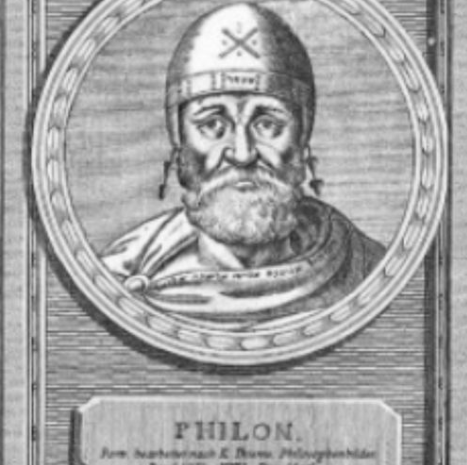
Thinkers understood the Logos in different ways. Heraclitus, a pre-Socratic philosopher from Ephesus, saw it as the rational principle that underpins change. The Stoics, a Hellenistic school of philosophy, held that reason pervades the entire universe. Meanwhile, Philo of Alexandria, a Hellenistic Jewish thinker, described the Logos as the mediating word of the God of Israel, bridging the transcendent God and the created world.[1]
John’s Logos also has deep roots in Jewish tradition. Even before John’s time, Israel’s sages viewed God’s Wisdom and Word as active forces in the creation and sustenance of the universe. In Proverbs, Wisdom is portrayed as existing at the moment of creation, alongside God when He formed the heavens.[2] Later Jewish writers expanded these ideas by casting Wisdom as the instrument by which God made all things, including making the Torah an earthly expression of God’s will.[3] A third strand, the Memra, or “Word,” of the LORD in the Aramaic Targums, underlies the same acts.[4]
These roots reach back to Genesis itself. Genesis 1:1 opens, “In the beginning God created the heavens and the earth,” and John 1:1 deliberately echoes it: “In the beginning was the Word.” Genesis also shows how God creates by speech (“Then God said, ‘Let there be light,’” Genesis 1:3), so that God is the source and His Word the agent through whom all things come to be.
For John, these traditions were not separate streams but a single converging current, and his move within it is singular: he does not merely personify the Word; he identifies it with a man who lived.
Point 1a: The Logos in Hellenistic-Jewish Thought Before John
Philo of Alexandria was born around 20 BCE and became a prominent Hellenistic-Jewish thinker during the time of Jesus and John the Baptist. Jewish by birth but Greek-educated and Greek-speaking, he studied Plato alongside the Torah. He read the Jewish scriptures through a philosophical lens more systematically than any earlier Jewish writer whose work survives.
What Philo added was a bridge to Greek thought. He treated Moses as the fountainhead of true philosophy. The best of Greek thought, Plato above all, he read as an echo of the wisdom Moses had received from God, so that Greek philosophy was not a rival to Judaism but a partial witness to it. Blending Platonic and Stoic categories with Israel’s scriptures, he recast them in philosophical terms.
In this way, he linked the Torah, regarded as God’s living word, with the Greek idea of the Logos. In Philo, Jewish Wisdom and Greek Logos merge, both serving as mediators between God and the world.
Philo’s own words show the Logos doing this double work:
- “Every man, regarding his intellect, is connected with [the divine Logos], being an impression of, or a fragment or ray of that blessed nature.”[5]
- “But the shadow of God is [the Logos], which he used like an instrument when he was making the world. And this shadow, and, as it were, model, is the archetype of other things.”[6]
- “… the two natures are indivisible; the nature, I mean, of the reasoning power in us, and of the divine Logos above us; but though they are indivisible themselves, they divide an innumerable multitude of other things.”[7]
Philo died around 50 CE, roughly when the first Christian writings were composed. The intellectual world he helped shape was Greek-speaking, philosophically literate, and accustomed to reading the Jewish scriptures through Platonic and Stoic categories. That is the world John writes into. Nothing puts John’s Gospel in direct contact with Philo’s writings, and the parallel is best read as shared vocabulary in a shared milieu rather than as dependence.
When John opens his Gospel with the Logos, a reader formed in that same Greek-speaking Jewish world would have heard echoes of both Genesis and the Logos speculation Philo represents. These currents were not mutually exclusive; a community could draw on Hellenistic philosophical vocabulary and Israel’s own scriptures at once.
The deeper roots of John’s Logos lie in Israel’s own scriptures, where Wisdom and the creative Word of God had long done the work John would later assign to the Logos.
Sirach pictures Wisdom setting up her tent in Israel (Sirach 24:8). The link is verbal, not merely thematic: where Sirach has Wisdom “pitch her tent,” John says the Word “became flesh and dwelt among us” (John 1:14), using a Greek verb (eskēnōsen) built on the same word for “tent” or “tabernacle.” Readers steeped in the Wisdom tradition would have heard Wisdom’s dwelling in Israel behind the Word’s dwelling in flesh.[8]
The Wisdom of Solomon uses the term itself. In Wisdom of Solomon 18:15-16, it is God’s “all-powerful word” (logos) that leaps down from heaven as the agent of judgment in Egypt. Here, a Jewish writer, well before John, already speaks of the divine Logos as an active agent, not only as a personified Wisdom figure.[9] The distance between the Wisdom tradition and the Logos of the philosophers was, in part, already closing inside Hellenistic Jewish scripture itself.
Philo’s synthesis faced outward, toward Greek philosophy. Beneath that outward turn, the two traditions had already merged within Jewish scripture, so that the term Logos could carry both the wisdom behind creation and the rational principle that orders the universe. That double resonance is what lets the Prologue speak at once to Jewish and Gentile readers. Even so, John presses the figure further than Philo or the earlier Wisdom writers had, giving the Logos a role and an activity beyond anything in his sources.
One feature of this Wisdom background sets up the question that follows. Proverbs 8:22 says, in Hebrew, that the LORD “possessed” or “acquired” Wisdom (qanah) before His works of creation, while the Septuagint renders the same verb “created” (ektisen). Read one way, Wisdom is eternal with God; read the other, she is His first creature.[10] John inherits both the tradition and its ambiguity, and that ambiguity is exactly the tension the next section takes up: whether the Word is God or a god.
Point 1b: Is the Word God or a god?
John 1:1 has been debated for centuries, and the debate turns on one point of Greek grammar rather than on any later doctrine. The argument here is that the grammar does not decide the matter because John did not build it to do so: he writes of a Logos who is identified with God and distinguished from Him, and he holds both without resolving them.
John’s vocabulary for God and for the Word overlaps, and that overlap is the whole difficulty. John 1:1 says, “… and the Logos was with ton theon, and theos was the Logos.” Most grammarians read theos, which appears without the definite article and precedes the verb in Greek word order, as qualitative. This means that it describes what the Word is rather than which “god” it is. In English, this is often translated as “the Word was God.”
Another reading takes theos as indefinite, translating the statement as “the Word was a god.”[11] Two questions need separating: whether theos is grammatically indefinite, and whether the Word ranks below the Father in nature, the view known as subordinationism.
John uses the article for God (ho theos) and drops it when he applies theos to the Logos, a contrast that looks deliberate. The same distinction appears in Philo of Alexandria’s writings. He reserves ho theos for God and calls the Logos theos without the article,[12] suggesting the anarthrous form was a recognized convention rather than an accident of style. John’s claim in verse 3 that all things came into being through the Word places the Word on the Creator’s side rather than among the things made.
Both Trinitarian and non-Trinitarian readings are grammatically available, and that is the finding, not a failure to choose. The ambiguity is not a gap the grammar left open by accident; it is what John wrote.
The binary of the later Trinitarian debate is a poor fit for what John writes, since he never poses the question in those terms. Today, most grammarians lean toward the qualitative reading rather than the indefinite one, following Philip Harner’s correction of Colwell’s rule. Colwell described a case in which a predicate noun already known to be definite drops the article, and the rule cannot be run in reverse to prove definiteness. Harner argued that an anarthrous predicate noun placed before the verb most naturally signals quality rather than an indefinite “a god.” [13]
The second question is older than the translation dispute itself: in John’s opening verses, is Jesus, the Logos, one with God, or distinct from Him? Later, John will call Jesus “monogenēs,” traditionally rendered “only begotten” and, in most modern translations, “only” or “one and only” Son, a term many scholars gloss as “unique” or “one of a kind,” language that invites the question.
Taken at face value, the family language of “Son” and “only begotten” suggests that the Son came from the Father as children come from parents, so that there was a point before which the Son did not exist. That is essentially the reading Arianism later defended, holding the Word to be divine yet created, a subordinate rather than an equal. The First Council of Nicaea (325 CE) ruled against it.
John’s own wording does not settle the question, and it never tries to. The same tension returns at the Prologue’s close and is taken up in Point 8. Trinitarianism has prevailed since the fourth century, but that later dominance tells us nothing about what John intended in the late first century.
Point 2: Life and Light (John 1:4-5)
John’s pairing of life and light draws on familiar Jewish imagery. He sets light against darkness to announce the Logos as “the Light of mankind,” a light the darkness does not overcome. At John 1:5, the Greek verb is katalambanō, rendered “grasp” in the NASB. Katalambanō carries both senses, to comprehend and to overpower, so the clause holds both readings at once: the darkness neither understood the light nor overwhelmed it.
One textual question determines how John 1:4 is read. The clause “what has come into being” (ho gegonen) can attach to either verse 3 or verse 4. The NASB keeps it with verse 3 (“not even one thing came into being that has come into being”), but many critical editors, including Aland’s Synopsis of the Four Gospels, attach it to verse 4 so that it reads: “What has come into being in Him was life.”
On that reading, the life John names is not merely present in the Logos but is the very existence creation received through Him, which tightens the link between the creative Word of John 1:3 and the life-giving light of John 1:4-5.
John’s pairing of life and light has deep scriptural roots going back to the first lines of Genesis. Genesis 1:3-4 records God’s first creative act as the making of light: “Then God said, ‘Let there be light’; and there was light. God saw that the light was good; and God separated the light from the darkness.” John has already tied his Prologue to Genesis 1:1, and the echo continues here. The light that shines in the darkness in John 1:5 recalls the light God spoke into being and set apart from the darkness at creation, so that the Logos through whom “all things came into being” is also the light by which creation was first ordered.
Beyond Genesis, the pairing runs throughout the tradition John’s audience knew. Psalm 36:9 joins the two directly: “For the fountain of life is with You; in Your light we see light.” The Wisdom tradition casts personified Wisdom as both a life-giver and “a reflection of eternal light” (Wisdom of Solomon 7:26). And the light motif reaches beyond the pairing itself: Isaiah 9:2 promises light to people in darkness, “The people who walk in darkness will see a great light; those who live in a dark land, the light will shine on them,” giving John a vocabulary in which light is what arrives for those sitting in darkness.
A close and roughly contemporary parallel appears in the writings of the Qumran community near the Dead Sea, whose scrolls date from the third century BCE to the first century CE. The Community Rule (1QS, columns 3 and 4) divides humanity into “sons of light” and “sons of darkness,” depicting two spirits, one of truth and one of deceit, contending in the world under God’s sovereignty. It remains uncertain whether John knew these texts, but they show that a moral dualism framed in such terms was already familiar to the Jewish community he addressed.
Read against this background, the Logos embodies divine life, the life that belongs to God and is given to His creatures, and that life has served as humanity’s light from the start. When John writes “life” and “light,” then, he means more than their ordinary senses; in the Prologue they name the Logos’s activity in the world.
If life is what the Logos offers, light shows how He reveals it. Later, in chapter 8, John connects life and light again. John 8:12 records Jesus saying, “I am the Light of the world; the one who follows Me will not walk in darkness, but will have the Light of life.”
Light and life are two faces of one gift: the Logos gives life, and that same life is what lets those who follow Him see.
Point 3: John the Baptist is not the light (John 1:6-9)
All four Gospels subordinate John the Baptist to Jesus: Mark casts him as the voice preparing the way, and Matthew and Luke have him defer to the mightier one coming after him. John goes further, reducing him from forerunner to witness, a man sent only to point beyond himself.
That this Gospel must say, “John was not the light…” implies it was written for an audience that included people who thought John the Baptist might be the light. A denial can be preemptive, but one repeated this insistently and this often more plausibly answers a claim that was actually being made. And this Gospel makes the denial more than once: in John 1:19-23, the Baptist openly rejects the titles “Messiah,” “Elijah,” and “the Prophet,” and in John 3:30 he insists, “He must increase, but I must decrease.”
By the 90s and early 100s, the Jesus movement was spreading but lacked central coordination.[14] Among the groups John’s community would have encountered were followers of John the Baptist who continued his movement after his death and regarded him as a figure of independent religious significance rather than a forerunner to someone else.
This distinct following is visible in the Synoptic tradition itself. In Luke 7:18-23 and its parallel at Matthew 11:2-6, the imprisoned Baptist sends his own disciples to ask Jesus, “Are You the Coming One, or are we to look for someone else?” The question presumes a recognizable body of followers who looked to John for direction during Jesus’s ministry, and for whom allegiance to Jesus was not yet settled.
Acts 18:24-19:7 may preserve a trace of it. The scene describes a group in Ephesus who know only of John’s baptism and must be told about Jesus, a hint that John’s movement still left a mark in the decades when the Third and Fourth Gospels were taking shape. Whether Luke means an organized Baptist sect or simply believers who had received only John’s baptism is debated, but either reading places John’s followers in Ephesus decades after his death.
Josephus corroborates the Baptist’s independent stature. Writing in the 90s, he gives John the Baptist substantial treatment in his own right (Antiquities 18.116-119), describing him as a popular preacher with a following large enough that Herod Antipas executed him out of fear of his influence. Josephus never casts him as a forerunner to anyone. That a Jewish historian outside the Jesus movement could present John as a self-standing religious figure helps explain why the Fourth Gospel takes the time to argue against a competing religious leader.
When John wrote, the boundaries among Christian, Jewish, and other related movements were still forming, and it was unclear which groups would endure. Second Temple Judaism had fractured after Rome destroyed the Temple in 70 CE, and the rabbinic Judaism that would later dominate had not yet consolidated. In that unsettled interval, several Jewish renewal movements competed for adherents, and the Gospel of John and Luke-Acts attest that a movement centered on the Baptist was among them.
The polemical function of the denial is well attested; John’s precise motive is not. Notably, John placed it at the beginning, within the philosophical introduction of Jesus as the Logos of God, rather than later when John the Baptist appears. Many scholars regard John 1:1-18 as a reworking of an earlier hymn or poem about the Logos, into which the two passages about the Baptist (John 1:6-8, 15) were later inserted.[15]
On that view, the Baptist verses interrupt the hymn, and the interruption is itself the evidence: the community that shaped the Prologue was willing to break open its own poem rather than leave the denial to the narrative.
Point 4: Who is Jesus? Who are His Followers? (John 1:10-13)
John describes Jesus’s life before His ministry with the phrase “He was in the world.” At first glance, the phrase might seem to place Jesus in an ordinary earthly life, the sort of quiet years a reader could infer from the other Gospels. In context, though, it follows immediately on “the world came into being through Him,” so John is speaking of the pre-existent Logos active in creation, not of hidden decades in Nazareth.
Luke narrates Jesus’s birth, circumcision, and a childhood episode at the Temple, while John mentions nothing before adulthood. Later, in John 7:25-44, an audience asks where Jesus comes from, and the crowd reaches no settled answer. When Jesus does respond (John 7:28), He turns the question away from His earthly origin toward the One who sent Him rather than naming a birthplace.
A similar hesitation occurs when others refer to Jesus as part of His human family. In John 1:45, Philip calls Him “the son of Joseph,” from Nazareth, and in John 6:42, a skeptical crowd questions if this is not Jesus, “the son of Joseph, whose father and mother we know.” In both instances, John presents these as the characters’ assumptions rather than his own account of Jesus’s origin. The crowd in John 6:42 is plainly mistaken, and Philip’s grasp proves incomplete as well, as Jesus later tells him directly (John 14:8-9); in neither case does the narrator adopt Joseph’s paternity in his own voice.
John’s origin story for Jesus says that “in the beginning” there was “the Word,” then that “He was in the world… which was made through Him…” What is missing is any account of how Jesus entered the world as a human being. John neither confirms nor denies the nativity. The one thing he does say about the Logos entering the world, that the Word “became flesh” (John 1:14), is an incarnation rather than a birth narrative; it describes a presence taking up residence among us, the subject of Point 5, not a child being born. His silence on Jesus’s mortal birth keeps the focus on a presence that was already there rather than on a birth that introduces Him. The silence is not accidental. It is the first move in John’s argument about origins.
Having established who Jesus is, John turns to who His people are. When he says that Jesus came to His own and they did not accept Him, “His own” most naturally denotes Israel, casting Jesus as the Jewish Messiah who comes to His own nation.
This sequence of a divine figure descending and being rejected was familiar in the Jewish Wisdom tradition. In 1 Enoch 42, Wisdom personified seeks a place among humans, finds none, and returns to heaven; similarly, Proverbs 1:20-33 narrates Wisdom’s descent and the indifference she meets.
John’s account closely follows this pattern: the Logos is in the world, yet the world does not recognize Him; He comes to His own, but they do not accept Him. When viewed through the Wisdom motif, John 1:10-11 depicts the arrival and rejection of a pre-existent figure rather than an ordinary return, highlighting a stark contrast: unlike Wisdom in 1 Enoch, who finds no home, John’s Logos will ultimately be accepted and find a dwelling (John 1:14).
Point 4a: Not of Blood, Will of the Flesh, Nor Will of a Man
For Jesus and His followers alike, ancestry does not determine standing before God. Followers become children of God by receiving Him and believing in His name (John 1:12), a standing that John 1:13 grounds in being “born of God” rather than in ethnic lineage or covenant symbol.
The same indifference to family lineage appears again in the Gospel. In John 19:25-27, at the cross, Jesus does not name His mother. He says to her, “Woman, here is your son,” and to the beloved disciple, “Here is your mother,” thereby binding her into the new family formed around Him rather than the biological one.
Entry into that new family is defined by a birth of a particular kind, which verse 13 specifies by exclusion: they were “born, not of blood nor of the will of the flesh nor of the will of a man, but of God.” In John 3:3, Jesus says to the Pharisee Nicodemus, “Truly, truly, I say to you, unless someone is born again, he cannot see the kingdom of God.” The word Jesus uses, anōthen, means both “again” and “from above,” and that double sense reinforces the point: the birth in view is not a repeat of physical birth but one that originates with God.
In other words, descent from Abraham, the common symbol of covenantal connection, does not, by itself, entitle a person to the kingdom of God; what counts is being born again, not biological lineage. Jesus reiterates this in John 8:39-44, where a group of Jews asserts, “Abraham is our father.” Jesus responds that their true spiritual father is the devil, judging by their deeds. Jesus does not deny the descent. At John 8:37, He grants outright that they are Abraham’s offspring. What He denies is that the descent counts for anything, since their actions align them with a different spiritual lineage.
Everything so far has taken John 1:13 as a statement about Jesus’s followers, and grammatically the plural “who were born” supports that. Read a second way, though, the same verse can be turned toward Jesus’s own origin: each of its three negations answers to an element of the Lukan or Matthean infancy narratives that John may be quietly setting aside.
The negation of “blood” sets aside the weight Luke and Matthew place on Jesus’s Davidic ancestry. Grammatically, John says the followers were “born of God,” but when read in relation to Jesus, the same logic renders descent from David moot. Jesus, as the Logos, supersedes any connection to David. The Logos predates even Abraham and Adam, the furthest ancestors named in Luke’s genealogy (Luke 3:34, 38). Luke does press past Adam to “the son of God” (Luke 3:38), so the two writers are not simply talking past each other. The difference is where each begins: Luke arrives at divine sonship at the end of a human line, while John starts there and never supplies the line at all.
The “will of the flesh” is the hardest of the three to pin to a single tradition. It is also where the strongest objection to this whole reading lands: if “flesh” names the ordinary process by which a child is conceived, then denying it could be read as affirming the virginal conception that Matthew and Luke narrate, not setting it aside. John’s reticence blunts the objection without dissolving it. He never tells the story of the conception in any form, natural or miraculous, so the negation cannot be read as endorsing one account of how Jesus was conceived over another; it declines the question, grounding His arrival in God’s will rather than in any birth reported by the other Gospels.
It should be granted, though, that this middle term carries less weight than the other two. Blood points to a genealogy and the will of a man to a named act, while the will of the flesh points only to the absence of a story. The three-allusion reading rests on its outer two terms. At Luke 1:38, Mary replies, “Behold, the Lord’s bond-servant…,” and Luke makes her assent the human hinge of the incarnation; John names neither Mary nor her consent, attributing Jesus’s coming entirely to divine action. The point is not about Mary but about location: John refuses to place the Logos’s entry into flesh in any human will or generative act.
The “will of a man” plays a key role in Matthew and Luke. In Matthew, Joseph accepts the child only after a dream directs him to. Luke never makes Joseph’s will explicit. He shows Joseph acting as head of the household, registering at Bethlehem with Mary and traveling with her to the Temple at Passover (Luke 2:4-5, 41), which implies consent without ever stating it.
Both Luke and Matthew provide detailed genealogies connecting Joseph to David and other ancestors. In Matthew, Joseph’s choice to acknowledge Jesus as his son confirms His connection to David’s line. Here too John declines the tradition: no human decision or adoption can define Jesus’s identity. The Davidic lineage, which Matthew grounds in Joseph’s act of acknowledgment, carries no weight in John’s account.
The Greek phrase for “will of a man” is thelēma andros. Andros is the genitive of anēr, a noun meaning both “husband” and “man.” Typically, this section is interpreted as three negations that collectively deny normal human procreation. The reading offered here takes them instead as three separate allusions to rival origin traditions rather than as a single parallelism. The specificity of “will of a man” (thelēma andros), a husband’s decision, points to Joseph’s acknowledgment of Jesus in Matthew more than to conception in general, and read with the negation of blood, it suggests John knew other Gospel accounts and set aside what they claim about Jesus’s origin. That John knew the Synoptic infancy material is itself contested, so this is best held as a reading the text invites rather than a settled conclusion.
Point 5: The Dwelling, the Tabernacle (John 1:14)
John says that the Logos “… dwelt among us.” In Greek, the verb is eskēnōsen, meaning “pitched his tent.” As noted in Point 1, the same verb underlies Sirach’s image of Wisdom pitching her tent in Israel (Sirach 24:8), so the Wisdom echo introduced there and the Tabernacle echo developed here hinge on one word. This verb is built on skēnē, the word the Septuagint uses for the Tabernacle, the portable sanctuary that accompanied Israel through the wilderness in Exodus.[16]
A Greek-speaking Jewish reader steeped in the Septuagint would likely have caught that connection. The Tabernacle was more than a tent; it was where God’s presence and visible glory dwelt among His people.[17] John presents the Logos becoming flesh as that dwelling returning, now in a human life, an echo of the prophetic hope that the glory which had departed the Temple would one day return (Ezekiel 10 and 43).
The first half of John 1:14 establishes the Tabernacle imagery with the verb “dwelt.” The glory in its second half then reaches back to Exodus 40:34, which reads: “34 Then the cloud covered the tent of meeting, and the glory of the LORD filled the tabernacle. 35 And Moses was not able to enter the tent of meeting because the cloud had settled on it, and the glory of the LORD filled the tabernacle.”
At the tent of meeting, the glory was so dense that Moses could not enter; in the incarnation, that same glory takes up residence in a human life that can be approached, followed, and beheld. John depicts Jesus as the new earthly tabernacle and describes Him as the Son, full of grace and truth. The phrase “grace and truth” echoes the covenant self-description God gives Moses on Sinai (Exodus 34:6). Point 7 takes up that phrase and its Hebrew background (ḥesed we’emet) in full.
John sets that covenant self-description in the flesh of the Logos, a link he makes explicit three verses later (John 1:17). Those who received Him (the Logos, the only Son) saw in Him the same glory the Israelites had seen in the Tabernacle. That glory is not confined to the Prologue: John shows it again at Cana, where Jesus reveals His glory (John 2:11), and ties it to Jesus’s execution through the language of the “hour” and His glorification (John 12:23 and 17:1-5).
John 1:14 marks the renewal of God’s presence among His people, now in Jesus. The weight of the verse falls on its first-person plural, “we saw His glory.” John’s community presents itself as the heirs of eyewitnesses who beheld that glory firsthand, as Israel did at the tent of meeting. That claim of testimony sets up the Baptist’s public cry in the following verses.
Point 6: The Baptist’s Cry (John 1:15)
15 John testified about Him and called out, saying, “This was He of whom I said, ‘He who is coming after me has proved to be my superior, because He existed before me.’”
The NASB 2020 renders the line, ‘He who is coming after me has proved to be my superior, because He existed before me.’ Smoothed into English, the paradox nearly disappears. The Greek keeps its awkwardness: “the one coming after me, in front of me has come to be, because before me he was.”
The sentence is dense because it layers three concepts: “after” (in time), “ahead of” (in rank), and “before” (in existence). The layering is deliberate, and the tension it produces is the point.
The third term, “before me,” carries the weight. The Greek is prōtos mou, literally “first of me,” and prōtos with the genitive works as a comparative: “earlier than me.” The one who comes after John in ministry already existed before him.[18]
On its own, the phrase claims only that Jesus existed before John. The opening of the Prologue, where the Logos is described as “in the beginning” (John 1:1-3), pushes this precedence back to before all creation, echoing the Wisdom tradition, in which personified Wisdom is established “from eternity,” before the world began (Proverbs 8:22-23). When read in this light, the Baptist’s “before me” serves as personal testimony to the pre-existence emphasized earlier in the text.
Mark, Matthew, and Luke carry the saying in simpler form. At Mark 1:7, Matthew 3:11, and Luke 3:16, it turns only on rank and order, with no hint of pre-existence. John carries the same “coming after me” framework, whether from the Synoptics directly or from the common tradition behind them, and joins to it the clause “He existed before me.” That addition shifts the saying from sequence and rank toward a claim of Jesus’s pre-existence. John reiterates this idea a few verses later at John 1:30, stating, “After me is coming a Man who has proved to be my superior, because He existed before me.”
John begins his Gospel by asserting that the Logos, who became flesh as Jesus, has been with God since the beginning. John the Baptist, the first witness in the Gospel, then confirms it in his own words. Here, his testimony extends beyond Jesus’s rank to His pre-existence. As with the Baptist material in verses 6-8 (Point 3), John 1:15 is often seen as another such interruption within the hymn,[19] and its placement is telling: the Baptist is made to witness to the pre-existent Word at the very point where the poem reaches the Word becoming flesh. That testimony also does the work the other Gospels assign to a birth. Matthew and Luke establish who Jesus is by tracing His origins. John has his first human witness place Jesus’s origin ahead of his own, further back than any genealogy can reach.
Point 7: Grace in place of grace (John 1:16-17)
In the original Greek, the phrase is “charin anti charitos,” literally “grace in place of grace.” The preposition anti normally means “instead of” or “in exchange for,” which is why the line can be read as one grace replacing another rather than the more familiar “grace upon grace.”[20]
This difference runs deeper than translation. The two renderings pull in opposite directions: “grace in place of grace” suggests one gift replacing another, while “grace upon grace” suggests a gift added to a gift. The preposition favors the first; the scriptural background John draws on favors the second. This section sets out both cases without forcing a choice, on the same grounds as Point 1b: what looks like an unresolved reading is more plausibly a reading John left unresolved.
The exchange sense fits what John says next. Verse 17 sets the two gifts side by side: “the Law was given through Moses; grace and truth were realized through Jesus Christ,” highlighting a distinction between the Law and Jesus’s offering. On that reading, the Law was a gift, but one belonging to an era that Jesus’s arrival brought to a close.
The clearest scriptural warrant for one order giving way to another is Isaiah 43:18-19, which says, “Do not call to mind the former things, or consider things of the past. Behold, I am going to do something new, now it will spring up…” On the replacement reading, Isaiah is not merely renewing the past but announcing something that supersedes it, and John presses the point further toward covenant replacement. His Gospel makes it explicit later, at the Wedding at Cana. In that scene, new wine is provided to replace the wine that has run dry.
Later, Jesus expels the money changers from the Temple and then challenges His Jewish opponents, saying, “Destroy this temple, and in three days I will raise it…” John explains that Jesus was speaking about His body as the temple. Even here the same pattern recurs: the new temple displaces the old place of worship.
Both scenes come from John 2, later in the chronology this series follows, so they are offered here as anticipation rather than proof. Each reads cleanly as replacement, yet the sources examined next complicate that reading, beginning with Isaiah 43 itself, the witness just called in its support.
The strongest case for restoration begins with a detail in John 1:17. The phrase “grace and truth” (charis kai alētheia) is often viewed as the Greek equivalent of the Hebrew ḥesed we’emet, which denotes covenant faithfulness that God declares to Moses at Mount Sinai (Exodus 34:6). If John intentionally selected these words, then the qualities he attributes to Jesus are the ones first revealed to Moses.
The surrounding context supports this link: God speaks these words in Exodus 34 during the renewal of the covenant following the incident with the golden calf, offering grace once more to a people who had just broken it. The grace and truth shown to Moses were acts of covenant renewal, a theme that John mirrors by attributing these qualities to Jesus. On that reading, verse 17 does not dismiss the grace given through the Law; it presents Jesus’s grace as both new and a restoration of what the covenant had already promised.
Philo supplies a contemporary parallel. He depicts God withholding His initial gifts until the recipient is full, then giving fresh ones in succession, so that grace follows grace without interruption (De Posteritate Caini 145). John’s own wording leans in the same direction: verse 16 begins, “of His fullness we have all received,” evoking an image of overflow that aligns more with accumulation than with exchange.
The Johannine community may have considered itself the true Israel, a view raised in Point 4 and, in scholarship, associated with the synagogue conflict reconstructed by J. Louis Martyn.[21] That self-understanding fits restoration better than replacement, and so do John’s sources: Isaiah’s “new thing” is a new exodus, and the “grace and truth” of Exodus 34 were first spoken as Israel’s covenant was restored after the golden calf.
Paul reaches for the same Mosaic backdrop in 2 Corinthians 3, weighing the fading glory of Moses’s ministry against the greater glory that remains. In this reading, John’s warning is not against the Law but against those who let the covenant run dry, like the wine at Cana, and he claims that, in Jesus, it is filled again.
One note on the English, which lies outside the period this series works in. “Grace for grace,” an exchange rendering, held the field from the King James Version of 1611 through the American Standard Version of 1901; “grace upon grace” enters with the Revised Standard Version in 1946 and becomes standard after it. The familiar phrasing is therefore recent, and whatever moved translators in the twentieth century has no bearing on what anti meant to a first-century writer.
Point 8: The Closing of the Prologue (John 1:18)
John 1:18 depends on a textual variant, not just a translation choice. The earliest manuscripts read monogenēs theos, meaning “the only begotten God,” while later manuscripts read ho monogenēs huios, or “the only Son.” The theos reading appears in the oldest Alexandrian texts, including P66, P75, Sinaiticus, and Vaticanus[22]. The NASB’s “God the only Son” adopts the earlier theos reading, choosing the more difficult wording over a simpler one. Literally, it says, “No one has ever seen God. The only begotten God (the one in the bosom of the Father), He has made Him known.”
One title, theos, covers both God and the one who reveals Him, and a spatial image then separates them: the revealer lies “in the bosom of the Father.” The NASB renders kolpos as “in the arms of the Father,” but the older “bosom” better carries the intimacy of the word.
The shared title identifies Him with God; the spatial image sets Him beside God. The closeness never erases the distinction, and that is the ambiguity the Prologue has carried since verse 1. It surfaces again at “The Father, and I are one” (John 10:30) and “the Father is greater than I” (John 14:28). John holds the tension rather than resolving it.
This portrayal of the Logos as God’s revealer raises a question the Gospel goes on to explore. John presents Jesus as the Logos, God’s word made concrete, the one through whom God has always communicated. When read alongside John’s later statements that Isaiah “saw His glory” (John 12:41) and that Jesus declared, “before Abraham was born, I am” (John 8:58), the Prologue suggests that those who experienced God’s word in the Old Testament were encountering the Logos, who later took human form as Jesus.
Does Moses, then, speak to God on Mount Sinai, or to the Logos who became Jesus? The question is harder than it looks. Verse 18 insists that “no one has seen God at any time,” and Moses is the test case: in Exodus 33 he glimpses only part of God’s glory. John presses the point again later, telling his opponents they have “neither heard His voice at any time nor seen His form” (John 5:37).
He repeats this restriction in John 6:46, stating that “no one has seen the Father, except the One who is from God,” implying that only the Logos has seen God. He never directly answers the surface question. Still, his reasoning suggests that the Logos is how the one God has always made His presence known, so that to hear God’s word in the past was, in a sense, to encounter the one who became Jesus.
The Greek verb underlying both expressions, “has explained Him” and “has made Him known,” is exēgēsato, from which the English word “exegesis” is derived, meaning “to interpret” or “to draw out.” Jesus does not simply speak about God; He draws God out. The poem that opened with the Logos beside God closes with the Logos as the only route to Him. John’s elevated Christology does not stray from Jewish tradition. Still, it intensifies it: the same Word that created the universe, the Wisdom seeking a home in Israel, and the glory filling the Tabernacle now exist in a human life that can be followed and seen. That is why John starts not with a birth but with a beginning. The choice is also an argument. In declining to tell a birth story, he sets aside the claims of descent, conception, and a father’s acknowledgment on which Matthew and Luke rest their accounts. He places Jesus’s origin outside genealogy altogether, before creation itself. The Prologue is at once a Christological statement and a counter-narrative.
[1] On the Logos in Greek and Hellenistic thought: for Heraclitus, see the fragments at Diels-Kranz 22 B1, B2, and B50, with G. S. Kirk, J. E. Raven, and M. Schofield, The Presocratic Philosophers, 2nd ed. (Cambridge: Cambridge University Press, 1983), 187–212; on the Stoic logos as the immanent rational principle pervading the cosmos, see A. A. Long and D. N. Sedley, The Hellenistic Philosophers (Cambridge: Cambridge University Press, 1987), sections 44–46; on Philo’s Logos as mediator between the transcendent God and the created world, see De Cherubim 125–127 and Legum Allegoriae 3.96.
[2] Proverbs 8:22–31, where Wisdom is “brought forth” before the works of creation and stands beside God as He fixes the heavens; the term אָמוֹן (“craftsman” or “little child”) in v. 30 is disputed but in either reading places Wisdom at His side.
[3] See Sirach 24:1–23, which identifies personified Wisdom with the Law of Moses, and Wisdom of Solomon 7:22–8:1, where Wisdom is “the fashioner of all things” (πάντων τεχνῖτις).
[4] On the Memra (“Word”) of the Targums as a circumlocution for God in creation and revelation, see Targum Neofiti at Genesis 1:1; cf. M. McNamara, Targum and Testament Revisited, ad loc.
[5] Philo, De Opificio Mundi 146 (trans. C. D. Yonge, adapted).
[6] Philo, Legum Allegoriae 3.96 (trans. C. D. Yonge, adapted), interpreting Bezalel (Exodus 31:2) as a figure of the Logos, the instrument God used in making the world.
[7] Philo, Quis Rerum Divinarum Heres (Who Is the Heir of Divine Things) 234–236 (trans. C. D. Yonge, adapted).
[8] On the verbal echo of Sirach 24:8, where personified Wisdom “pitches her tent” (kataskēnoō) in Israel, behind John’s eskēnōsen in 1:14, see Brown, The Gospel According to John (I–XII); and Keener, The Gospel of John, at 1:14. The tabernacle background of the verb is developed at Point 5.
[9] Wisdom of Solomon 18:15–16, where God’s “all-powerful word” (pantodynamos logos) leaps from heaven as agent of judgment on Egypt; a pre-Christian Jewish personification of the divine logos as an active agent. See Keener, The Gospel of John, at 1:1.
[10] On Proverbs 8:22, the Hebrew qanah (“acquired,” “possessed”) is rendered ektisen (“created”) in the Septuagint. The divergence let later readers cast Wisdom as either eternal with God or His first creature, and it became a proof text in the fourth-century Arian debate. See Brown, The Gospel According to John (I–XII), at 1:1.
[11] The closest modern parallel is the Jehovah’s Witnesses’ New World Translation, which renders the clause “the Word was a god.” Other non-Trinitarian groups, including some Unitarian bodies and the Latter-day Saints, hold that the Word is distinct from and subordinate to the Father, though on differing grounds. On the New World Translation rendering, see Jason David BeDuhn, Truth in Translation: Accuracy and Bias in English Translations of the New Testament (Lanham, MD: University Press of America, 2003), esp. ch. 11.
[12] Philo, De Somniis 1.229–230, who likewise reserves ho theos for God and applies theos without the article to the Logos.
[13] See E. C. Colwell, “A Definite Rule for the Use of the Article in the Greek New Testament,” Journal of Biblical Literature 52 (1933): 12–21; Philip B. Harner, “Qualitative Anarthrous Predicate Nouns: Mark 15:39 and John 1:1,” Journal of Biblical Literature 92 (1973): 75–87; and Daniel B. Wallace, Greek Grammar Beyond the Basics (Grand Rapids: Zondervan, 1996), 256–70, who cautions against overextending Colwell’s rule.
[14] The Fourth Gospel is generally dated to c. 90–110 CE; see Raymond E. Brown, The Gospel According to John (I–XII), Anchor Bible 29 (Garden City, NY: Doubleday, 1966), Introduction.
[15] For the source-critical view that an earlier Logos hymn underlies the Prologue, with the Baptist material (John 1:6–8, 15) added as later prose insertions, see Rudolf Bultmann, The Gospel of John: A Commentary, trans. G. R. Beasley-Murray (Oxford: Blackwell, 1971); and Raymond E. Brown, The Gospel According to John (I–XII), Anchor Bible 29 (Garden City, NY: Doubleday, 1966), Introduction.
[16] The verb eskēnōsen derives from skēnoō, “to pitch a tent,” and echoes skēnē, the Septuagint’s term for the Tabernacle (also the “tent of meeting”). Many commentators also hear a play on the Hebrew shakan, “to dwell,” and the related rabbinic term Shekinah, used for God’s dwelling presence. However, the resemblance between the Greek and Hebrew roots may be coincidental. See Raymond E. Brown, The Gospel According to John, Anchor Bible; and Craig S. Keener, The Gospel of John: A Commentary, at John 1:14.
[17] The same Targumim discussed at Point 1 pair the Memra (“Word”) with the Shekinah (“presence”), the term for God’s dwelling among Israel. That pairing offers a close parallel in Jewish context to John’s tabernacle imagery here: the Logos takes up residence, as the glory once did, in the tent. See Brown, The Gospel According to John, on the Memra and Shekinah background to the Prologue.
[18] On πρῶτός μου as a comparative with the genitive (“prior to me,” “before me”), see BDAG, s.v. πρῶτος (comparative use with the genitive); cf. C. K. Barrett, The Gospel According to St John, ad loc. 1:15.
[19] Brown, The Gospel According to John (I–XII), 21–23, reconstructs the Prologue as an originally independent hymn and treats the Baptist material of verses 6–9 and 15 as prose additions inserted into it.
[20] On the disputed sense of anti here, see Ruth B. Edwards, “Χάρις ἀντὶ χάριτος (John 1:16): Grace for Grace,” Journal for the Study of the New Testament 32 (1988): 3–15, who sets out the three main readings (substitution, accumulation, and correspondence); C. K. Barrett, The Gospel According to St John, 2nd ed. (London: SPCK, 1978), on 1:16, who links the phrase to Philo’s language of grace succeeding grace; and Craig S. Keener, The Gospel of John: A Commentary, on 1:16.
[21] J. Louis Martyn, History and Theology in the Fourth Gospel, 3rd ed. (Louisville: Westminster John Knox, 2003).
[22] Bruce M. Metzger, A Textual Commentary on the Greek New Testament, 2nd ed. (Stuttgart: Deutsche Bibelgesellschaft, 1994), at John 1:18.
Leave a Reply