In 1986 my parents bought an Apple IIe computer. These computers were really expensive back then and they bought it because my dad had joined a “Rotisserie Baseball League” and wanted to tracks stats. The Apple IIe had a spreadsheet tool, an early ancestor of Microsoft Excel, that was great for inputting baseball stats and saving them from week to week.
I was 10 years old at the time and this new way of tracking baseball stats meant that I had something to do with my dad. He would type numbers in to the computer and I would read box scores to him. Each Sunday we would sit down and input a week’s worth of stats for 300 players across 10 teams in our league. Putting all the data in took most of a Sunday night.
For me it meant I had my dad’s attention for 4 hours. I wasn’t spending my Sunday nights on this because I loved baseball, I was doing this because it gave me an activity to do with my dad. The love of baseball came later for me but it was my path to becoming a baseball fan.
Because I started with the numbers I think I noticed something that most smart baseball fans didn’t notice until they were much older: Many of the stats in baseball don’t make any sense. The most common example, which I will discuss here, is Batting Average.
My dad’s league was what today is called a 5×5 league. That means there are 5 hitting and 5 pitching categories that you can get points in. If you win a category you get 10 points. If you finish last you get 1 point for that category. Back in 1986 the offensive categories were: Batting Average, Home Runs, RBI’s, Runs, and Stolen Bases.
To calculate Batting Average you divide hits by at bats. A hit is when the player gets on base by single, double, triple, or home run. And an at bat is when a player bats and either gets a hit or gets out (plus a few other things). Here is the problem: The are quite a few things that can happen when the player comes to bat that results in the at bat not counting. For example:
If a player comes up to bat with the bases loaded and takes a walk. The player records an RBI, which counts towards one of our league categories. Our player is on first when the next batter hits the ball. The runner on third scores but the opponent throws out the runner moving from second at third base; so our player is now on 2nd base with no one in front of him. Our player steals 3rd base, thus recording another stat in our league. The next hitter hits a single and our player scores a run.
To summarize the scenario: The player didn’t record an at bat, because he walked, but he did score a run, an rbi, and a stolen base. But in batting average terms this at bat did not count. At 10 years old I could see was that this did not make any sense.
Eventually I learned that there was a pretty well-known solution to my problem. There is a different stat called “On Base Percentage”. Where batting average is hits divided by at bats; on base percentage is hits + walks divided by total plate appearances (at bats plus walks, and some other stuff). Which means that in baseball people paid attention to a stupid stat and ignored a much more helpful stat for reasons that could be summarized simply as: “We’ve always done it that way.”
Let’s say a player gets 100 hits in 500 at bats. That’s a 200 batting average, which is considered terrible by major league standards. But let’s add that this player took 100 walks as well. His on base percentage is 200 divided by 600 or .333. a .333 OBP is a very good season. By 11 years old I could see things like this and I was ready for someone to pull the curtain back on all of baseball’s data flaws. I was ready for Bill James.
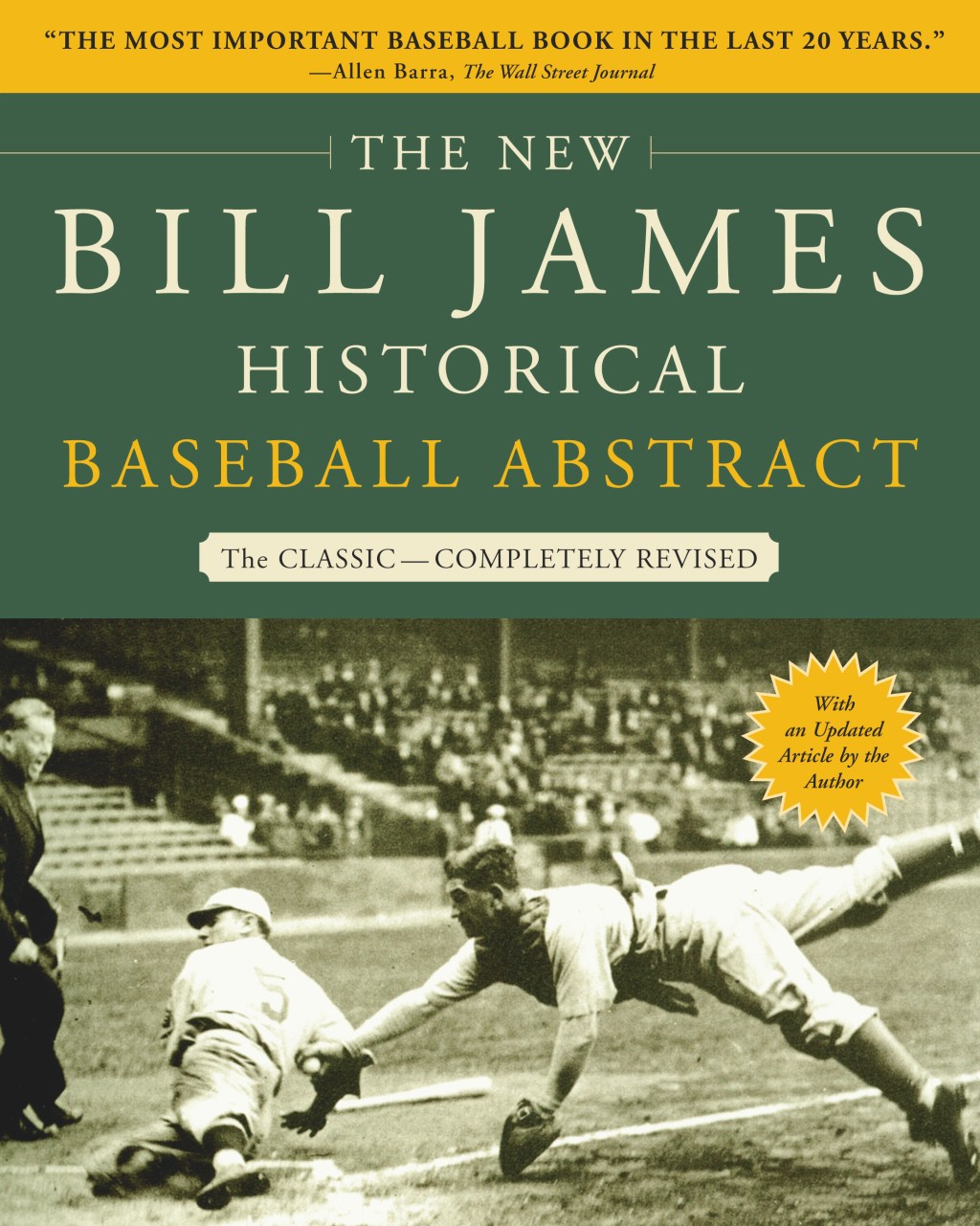
In 1973 Bill James completed his service time in the Army. He had a Bachelor’s and Master’s degree. He seemed poised to have a solid career doing something “business-y”. Instead he took a job as an overnight security guard in a canning factory.
James had joined the Society of American Baseball Research (SABR) and needed a job where he didn’t have distractions. He was obsessed with the secret world of baseball statistics and, most importantly, how baseball insiders fundamentally misunderstand their own sport. James wanted to make what he called “Sabermetrics” (a nod to the SABR Society) well understood by all of baseball.
James wrote a manifesto about baseball stats, which he called an ‘abstract’ and sent it for publication in major publications. James didn’t want to be famous, he wanted to improve the thinking in baseball. He was published nationally for a couple of years and then almost as quickly as he found publishers he was dropped. They didn’t think that people were interested in what he was saying.
This could have been the end of James’ story. Instead it turned out there was a small group of a certain type of baseball fan that had read James’ abstracts and wanted more. James would continue writing and would ‘self-publish’ his stuff by mail to this small group of people. After a few years of self-publishing he was sending his work to thousands of people. Soon James’ abstract was back; this time in Forbes magazine.
Forbes isn’t your typical baseball rag but it is a place that data nerds go to for information about investments, stocks, and so on. As it turns out baseball has a long history of data nerds arguing over the game. In the early 20th century scientists argued over whether hard breaking pitches actually moved or if it was an optical illusion. Detailed science papers were published on both sides of this debate. It wasn’t until freeze-frame and stop-motion tech came along that we could actually see the ball at various spots along its path could we prove who was right in this debate. The ball moved.
I bet that at the first baseball game in Cooperstown, NY there were a couple of nerds in the crowd arguing about the science of it all. And if one of these nerds were to read this they’d want to tell me that the first game probably wasn’t actually played in Cooperstown. This is a part of baseball. Bill James didn’t invent this. He was just the right kind of nerd at the right time.
By 1986 James was one of the most famous baseball “outsiders”. He had millions of readers and was driving opinions in and around the professional sport. Around 1986 was when Sparky Anderson, who had won the World Series as the manager of the Cincinnati Reds and again with the Detroit Tigers, called Bill James “a little fat guy with a beard who knows nothing about nothing.” It’s not a flattering quote but it does show that Anderson, the most insider of insiders in baseball at the time, new who James was.
Bill James’ ideas on baseball went from a self-published abstract, to the main fringe idea, to the core ethic of teams like the Oakland Athletics, to being at the heart of the book (and movie) Moneyball, to completely taking over baseball, and in many ways all major sports. Today if you watch sports on tv you will see all these stats and numbers. In baseball there’s exit velocity, launch angle, outcome probability, blah blah blah.
To be clear, Jamesian logic didn’t take over baseball just because it was right. And it wasn’t just because the nerds overwhelmed the sport. Being right is rarely a good enough reason for an institution as set in its ways as baseball was to change. And the nerds would never have found their way in to the sport without a good reason for the establishment to let them in.
No, the reason for baseball to change was two simultaneous events. The first was that the technology developed to allow for data to flow. It became cost-efficient and easy to track large volumes of data about the game. And it gets easier every year.
The main reason for the change to Sabrmetrics was salaries. At some point between 1973, when James wrote his first abstract, and the late 1990’s, when Moneyball takes place, is that salaries of baseball players went up dramatically. At some point most teams no longer wanted to pay for a player solely because someone’s gut told them it was a good idea to sign that guy. Teams needed something scientific to justify their expense decisions.
Bill James’ opinion of baseball was that past convention was wrong and that you could be smart about the game by using the data the right way. This is what I’ve come to think of as “Jamesian” logic. It’s summed up in the movie Moneyball when Jonah Hill’s character tells Brad Pitt’s character that the A’s losing their best player because they can’t afford him is a good thing. It creates opportunities to do interesting things with their budget instead of just pouring cash over the players’ heads. The A’s can get 4 players for cheap who can be combined to things that 2 expensive players did before.
“Jamesian” logic has a certain appeal. If you can see past this reality and in to the one made up solely of data then you can get to some higher level of key insights that are available only to the select few inspired souls. Another scene in Moneyball shows Billy Bean (Brad Pitt in the movie) watch the first pitch of the first game of the year and then get up to leave. Jonah Hill’s character wonders where he’s going and Pitt says he doesn’t watch the games because he doesn’t want to be fooled by his eyes. Don’t fall in love with a player just because he looks good in jeans.
There is an idealism to Jamesian thinking: All is knowable if you have enough data. You can demystify any problem through analytics. You can ignore anything if there is no data to support it. You can see the truth that no one sees if you trust reason and logic over emotion and the bias of your eyes.
But there is a flip side to Jamesian thinking. Ignoring things because there is no data doesn’t mean you shouldn’t be investigating those things. No data today does not mean there will never be data. And just because there is data does not mean that the data is right. To quote Albert Einstein “Information is not knowledge.”
In the 2010’s Bill James starting lashing out at his protégé’s in Sabermetrics. He pointed out that stats like “WAR” (Wins above Replacement) are just bad math pretending to be good math. People in baseball had evolved from trusting their eyes to trusting bad metrics. That was not a revolution but a step to the side; and certainly not what James had hoped to inspire.
James also noted that discounting things just because we don’t have the data cuts off exploration down the most important roads to go down. Just because we can’t evaluate something today doesn’t mean it doesn’t exist.
James’ goal was to evolve the conversation, not to solve every problem. James’ goal was to make baseball fans and insiders “as confused as ever, but on a higher level and about more important things.” They certainly are as confused as ever, but I’m not sure it’s on a higher level.
Additional Reading #1: Moneyball, by Michael Lewis:
The book and movie Moneyball are a great distillation of Sabermetrics and Jamesian thinking. The movie especially does a good job of showing the pros and cons of trying to be 100% logical in all decisions. It notes that eventually Billy Beane had to give in and acknowledge the humanity of the players as part of his path to success. If you have not seen the movie you should see it. If you have not read the book, it’s worth a read.
A note about Michael Lewis and Bill James:
In recent years James’ has come under fire for comments about how players were easily replaceable. It was seen as anti-union and probably led to the end of his career as an analyst for the Boston Red Sox.
In 2023 and 2024 James made several controversial comments on why cancel culture, wokeness, and other things are bad for baseball and society. James, who is now 74 years old, seems to be a very conservative person with something that would probably be considered pro-MAGA ideals. This posture has made many writers and baseball insiders say they appreciate what James has done for the game, but it’s time to get off of X and stop publicly commenting on things.
I mention this about James because I think there are many people who would find his recent takes to be bad ones. I used him as the avatar of my episode on logical thinking because of the impact his work had on me when I was a kid and then again as I was starting my post-college career through the book, and later the movie, Moneyball. James had a huge impact on how I see the world but I’ve also developed major objections to a world where everything is evaluated through pure analytics. I think James is a great avatar for this world view and his current takes don’t diminish his work in the 1970’s to 2010’s.
I recommend reading Moneyball by Michael Lewis in spite of the person I think Lewis has proven to be. For a full picture of Lewis I highly recommend the multi-part series of the podcast “Behind the Bastards” by Robert Evans where he discusses Lewis and his book about Sam Bankman-Fried called “Going Infinite.”
Lewis is a seriously problematic figure who clearly has a bias for wealthy men over people of other demographic categories. Lewis’ books like The Big Short and The Blind Side are examples of his tendency to be impressed by jerks who screw over other people to make a buck. That said the best Trump era book in my opinion was Premonition by Michael Lewis. It’s a book where the rich-white-jerk is the villain instead of the hero. Trump was so awful that even Lewis couldn’t find his way to being impressed by him. If you know someone who voted Trump in ’16, not Trump in ’20 and is thinking of going back to Trump you should have them read Premonition. It’s a great reminder that Covid was the thing that happened but it was just one of a bunch of things that could’ve happened. Trump in office again will make something disastrous happen because that’s how his influence is eventually felt by us all.
Additional Reading #2: The MVP Machine, by Ben Lindbergh and Travis Sawchik
The MVP Machine is a fascinating read about the modern analytics surrounding baseball. It looks at training facilities where players go to do deeply analytics-based micro changes to their grip on a baseball, to position of their arm when they throw, to changing their foot placement by millimeters all in the effort of getting 1% gains in some underlying performance metric.
Large sections of the book focus on a pitcher named Trevor Bauer. This is unfortunate because since the book came out Bauer has proven to have lots of personal problems which make him someone not worth reading about. In fact, one of Bill James’ ‘bad takes’ was in defense of Bauer. Even still the point about Bauer is that he rose to being one of the top handful of pitchers in all of baseball in spite of not being the most physically talented players by leaning in to the analytics and by being willing to do non-conventional things despite what people said about his practice techniques. Many of the things that all Major League Pitchers do now to train were invented by Trevor Bauer a decade or so ago.
The MVP Machine takes time to note that early adopters of the data revolution in baseball had to be willing to do things that looked “funny” to conventional baseball insiders. Weird warmups, using a cheat sheet in the Outfield, etc were things people were slow to use but the people who did had a huge advantage. This book talks through all of that and it is a great way to understand how baseball is using Jamesian thinking to move forward. It doesn’t seem possible that a book about how to increase spin rate on a baseball would be good reading. But I swear it is a totally fascinating book that is perfect for anyone who has ever had to do project management or problem solving professionally.
 More Important Things
Leave a comment