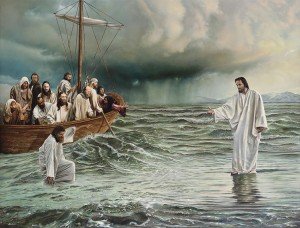
Quote: Immediately Jesus made the disciples get into the boat and go on ahead of him to the other side, while he dismissed the crowd. After he had dismissed them, he went up on a mountainside by himself to pray. Later that night, he was there alone, and the boat was already a considerable distance from land, buffeted by the waves because the wind was against it.
Shortly before dawn Jesus went out to them, walking on the water. When the disciples saw him walking on the water, they were terrified; “It’s a ghost!” they cried out in fear.
But Jesus immediately said to them: “Take courage! It is I. Do not be afraid.”
“Lord, if it’s you,” Peter replied, “tell me to come to you on the water.”
“Come,” Jesus said.
Then Peter got down out of the boat, walked on the water and came toward Jesus. But when Peter saw the wind, he was afraid and, beginning to sink, cried out, “Lord, save me!”
Immediately Jesus reached out his hand and caught him. “You of little faith,” he said, “why did you doubt?”
And when they climbed into the boat, the wind died down. Then those who were in the boat worshiped him, saying, “Truly you are the Son of God.”
End Quote, the Gospel of Matthew
In the first chapter we discussed what I called Jamesian thinking. That is an idea of the world that believes in only what you can prove and can analyze. Discard anything where there is no evidence.
In the second episode we looked at two stories from Taoism. Taoism asks you to disregard the distractions of this world and believe in what you can learn by striving for oneness with the Tao.
In this final chapter we will talk about taking things at face-value. Many Christians do this with the Bible and call it “Biblical Inerrancy.” The term Biblical Inerrancy comes with quite a bit of baggage that I am not looking to dissect. I am using the take on The Bible of Inerrantists for a certain point and not to go on a long discourse on its validity.
Many Christians in America today believe that the Bible is a literally true, historically accurate, and infallible document. This is often called “Biblical Inerrancy”. Now to be clear inerrancy as a belief system has many variations. It runs the gamut from people who assert that the Bible is a 100% perfect and divine book; to people who acknowledge the errors found therein but say that specific types of things in the Bible are inerrant.
I am not going to attempt to assemble a list of errors or inconsistencies here. If that is something you’re interested in then the book Misquoting Jesus by Bart Ehrman is a must-read for you. I am also not going to try to disabuse anyone of their faith in inerrancy. For that I recommend the Podcast “Straight White American Jesus” which has a whole series from late 2023 and early 2024 attacking the ideas of inerrancy.
My goal is to think about the way we think. Is taking what you heard from an authority figure and believing it 100% a good or bad way of thinking about things?
Unlike Bill James who encourages us to dig in to the data (Don’t trust your eyes, says Billy Beane in Moneyball). Believe what can be proven and doubt the rest. Biblical Inerrancy encourages Christians to hear a story like the “Jesus Walks on Water” one and take it ONLY at face value. If you wanted to take a Bill James approach to the story and calculate the odds of its truth, or study a map to find the mountain near the Sea of Galilee a Bible Inerrantist would tell you not to do that. Believe it because it is in the bible and because the elders at church said it is so. Therefore, it is so.
As the saying amongst fundamental Christians goes: The Bible Says It, I Believe It, That Settles It
The Taoist would have another view of this story. The truth of the story is not in its history or accuracy but in what we can learn from it. If you believe it is literally true then it is a story of how Jesus was like Superman. He calms the winds, he walks on water, he flies down off a mountain, he saves the day for all in the boat. All that is missing from this story is Jesus in a cape and some weird underwear that he wears on the outside of his clothes for no good reason.
It is a story that explains just how powerful Jesus is. You should believe in Jesus because he is Superman.
Personally, I don’t think “Superman Jesus” is very helpful to most of us. Unless he is physically present and actively saving the day then how does it help you that he flew around 2,000 years ago? Instead, I think the more helpful Jesus is the metaphorical one. Let’s take a look at the metaphor:
Metaphorically the sea could be seen as life. The boat, with its passengers, represents all of us trying to get through life. In life there are problems and challenges; and the storms and waves represent those problems.
When Jesus is away there is no way to make progress. You cannot make it on your own. When Jesus returns to boat he tells Peter, as a stand-in for all of us, that you don’t really need Jesus to make it through life. If you were perfect and pure-of-thoughts you could simply get out of the boat, like Jesus, and walk where you needed to go. Jesus let’s us know that we have that potential inside us if we could only get past our sin to realize it. But since you are just an imperfect human, since you have the stain of sin on you, you cannot walk on the water and you do need to sail across. You need to get Jesus in your boat.
Once Jesus is back in the boat the waters calm, the storm ends and the boat gets across the sea. The story stops being about how the only way to make it is to have Superman flying around solving problems for you and instead becomes symbolic. You need Jesus in your life (in your boat) to make it to the other side so you don’t drown on the way.
Another aspect to this story as metaphor that I find interesting: What does Jesus do when he is not in the boat? Nothing. There is a shorthand saying for this: “Without you God wont, without God you can’t.”
In this story the need goes both ways. Without the disciples Jesus is not converting anyone; he is just sitting up on a mountain doing nothing for the world. As a metaphor the story says that Jesus needs us to bring him in to the boat to have an impact. If we don’t bring him on board then nothing good happens: Jesus prays by himself on a mountain while we drown in the middle of the sea.
Another thing to consider as metaphor. If you know your Old Testament then you know the story of Moses leading the Jews out of Egypt. As Moses and his people flee the Pharoah they run in to the Red Sea and cannot cross. To get across to the desert on the other side God intervenes and parts the sea.
The Matthew story gives us a clear image of where Jesus ranks vis-à-vis Moses. Jesus does not need God’s help to get across a body of water. Where Moses needs the sea parted; Jesus can just walk over it.
One last thing I think is worth thinking about with this story: Today you will often hear conservative Christians talk about how judgement is coming. They say judgement is a penalty phase coming in the form of doom and tribulation. The righteous will be saved from the calamity but be clear that God is coming to enact his judgement on the wicked and sinful.
I think this is wrong. Without you God won’t. This means to me that God isn’t coming to punish and save. He has already provided a path to salvation. It is up to all of us to find our way to it. Waiting for God to come and fix things isn’t where it’s at. The Jews waited for God to fix things and it got their temple destroyed by the Romans and their people scattered across the Empire. I believe the story in Matthew is saying that sitting and waiting for God to intervene is a fools’ philosophy.
I started off talking about literalism and inerrancy and then spent a while on looking at the story in a totally different way. I think the stories of the Bible are much more interesting as metaphor and advice than as literal truth. While I think the story is a metaphor with a much wider meaning than simply what’s in the story; that doesn’t mean I said I think the story is false. The truth or metaphor question has always seemed totally irrelevant to me and therefore doesn’t matter.
I don’t want to get cute about it. I honestly don’t believe Jesus walked on water or flew off a mountain. But I see no reason why there couldn’t be a real story about the disciples preaching in the area during a storm that got turned in to this. It doesn’t change anything for me either way.
Ok. Now let’s go back to why one might be better off not thinking about the metaphorical and sticking to the literal.
Most Americans who are part of Christian faith organizations are not the ones who get to decide how their community will engage with the Bible or their faith. They are part of the flock, not the shepherd.
As the flock this means that if you are born to a devout Christian family and all of your family, friends, neighbors, etc. are all conservative Christians then there is real risk to even considering the story I started off with from Matthew as a metaphor. If you bring this up you may be disowned by your family. You may be shunned by neighbors. You may derive most of your social activities through church and risk losing access to all of it. You do not want to be the one with scary views that put you at odds with the established beliefs.
Considering the risks, it makes it very understandable why someone would hew to a literal or inerrant view even if they think that belief may have some flaws. Over the years I’ve talked to people of faith who hear some of what I have to say and stop me with a comment like “I want to believe the way I believe and don’t need you messing that up for me.” That’s a dismissal of the discussion on the grounds that they don’t want to find out. They are aware they may have a gap in their understanding but they also have no interest in filling that gap.
This type of thing arises when acceptance of literalist beliefs is because your proximity to it is so close that you cannot risk not accepting any part of a set of beliefs. Your life, or at least your well-being, may literally depend on it.
There is also the opposite reason many people believe the Bible is literally true. They are not Christian and not particularly interested in it. They don’t have any of the risks the person I mentioned in the last paragraphs does. What they have is a basic social understanding of others’ beliefs and they don’t really know, or care to know, enough to disagree with the view. This thinking goes like this: “Those super-Christians I knew when I was in High School said it was literal truth and maybe it is. Sounds good to me; it doesn’t really change my life either way whether a guy 2,000 years ago walked on water or not.”
I heard Chris Hayes comment on “low information voters” once. Low Information Voters are people who are likely to vote in an election but at present really know nothing about what any candidates stand for or what they’re records as politicians are. Hayes noted that he has a bias because he is so dialed in to politics that he cannot imagine these people. But then he notes that we all have things we know little about but may have an opinion on. Chris Hayes mentions that he doesn’t follow hockey, for example, and yet has thoughts on hockey.
I think hockey is a great example. Even if you know zero about hockey you probably know that Wayne Gretzky is the greatest hockey player who ever lived. But is that true? Is he really the greatest? What facts and data do you have to back that up? Is there a debate amongst hockey experts about this?
As it turns out there isn’t much debate about Gretzky. But if you search around you can find some people who argue for Gordie Howe, Bobby Orr, or even Mario Lemieux. Alex Ovechkin is a current NHL Player as I write this who is closing in on Gretzky’s record for career goals. The point isn’t whether Gretzky is or is not the greatest. The point is that a non-hockey fan probably believes it is true even though they have no idea.
Taking something literally or at face-value when the stakes in doing so are super-low is pretty common. Matthew says Jesus walked on water and ESPN says Gretzky was the GOAT. Thinking about these things isn’t a priority and neither of them change your day-to-day life if you’re not a devout Christian or a hockey fan. We do this all of the time with a million things that our mind simply doesn’t have time for and accepting the standard line is good enough. We hear it, accept it, and move on.
Now let us circle back to a group I left out before. I mentioned the flock whose continued membership in their family and organizations may depend on believing something. And I mentioned people at a distance who have no stake in belief or disbelief. But what about the people who set the belief system for their community? What do they get out of requiring their flock to believe the Bible is literally true?
Literalism is not necessary to gain followers. Literalism is not required to claim your book is divine. It would be entirely possible for the book to be seen as written by God and also a work of fictions or parables. If you believe God is all-powerful then who are you to say his book has to be literal history?
Taoism makes no such claim to literalism and there are millions of dedicated followers of the Tao. You can have a metaphorical Bible and still claim it as an inspired or divine text.
The problem for leaders of a flock is that once you acknowledge that your main book is full of metaphors then you are allowing for interpretation. Once you allow for interpretation then you are ceding ground to the flock to decide what is being said. It is much easier to be in charge if you can say you are the authority and you have a book written by God that has ALL the answers with literal and absolute certainty.
Because you are the authority you get to decide that the passage about man laying with man means gay people are bad. You are the authority so you get to decide that “there is no male or female, for you are all one in Christ Jesus” from Galatians does not mean everyone is allowed.
Because you are the authority you get to decide that Eve comes from Adam’s rib so women are inferior. However, you get to dismiss Paul’s prominent disciple Junia as either being a man with a woman’s name or some other mistake (even though the bible is inerrant this is somehow a mistake).
Because you are the authority you get to decide that black people belonging in a second class or slave state is justified by the story of the Curse of Ham from Genesis. Because you are the authority you get to disregard Philemon where Paul admonishes a slave owner for owning fellow Christians as slaves. Paul says “If you count me as a partner <in Christ> you should receive him (your slave) as you would receive me (Paul).” Would a slave owner enslave Paul? Certainly not! But if you, as the authority, decide not to acknowledge this book of the bible then seeing blacks as inferior is justified biblically.
And if you aren’t sure about the lengths authority would go in American history to ‘ignore’ parts of the Bible just know that in the 1800s there existed a “slave’s bible” that did not include about 90% of the Old Testament or about 50% of the New Testament. Philemon was certainly not a letter of Paul’s that slave holders wanted their slaves to see in 1800’s America.
My hope with talking about Jamesian thinking, Taoist thinking, and then a few views on Biblical thinking like Inerrancy and Metaphor was not to convince you that any one way was right or wrong. I think they all have value in their place. The real value is being able to think like Bill James when the time calls for it and then being able to pivot to seeing the world more abstractly when that need is there.
Bringing Taoist philosophy to data analytics probably doesn’t make sense. Just like deciding on religion using Bill James would fall flat. I tried to be fair to literalism but I will confess that this is difficult. The point of this show is to break down the face-value narratives and so that world view won’t find much shelter here.
In the end I was hoping to get you thinking about thinking. I hope that I’ve said some things that were things you hadn’t thought of before. I prefer discussion and not absolutes. I prefer to know that we don’t have all of the answers; that we are just as confused as ever, but on a higher level and about more important things.
Additional Reading: God & Empire and Render Unto Caesar, by John Dominic Crossan
I’ve never been to the Sea of Galilee. It’s one of those places I hope to get to someday if I’m able. Though I’m not a religious person I am a big fan of history. So far my only access to a place like Galilee is through YouTube videos or by reading books like Crossan’s. Crossan wrote his Walking in the Footsteps of Jesus and Walking in the Footsteps of Paul books which give you a feeling like you’re almost there; both in the first century but today as well.
Much of this episode comes from my years of dedicatedly listening to people like Crossan. If you are familiar with him there were probably several points in this episode where you heard Crossan’s influence.
Because of Crossan one of the things I have thought a lot about in recent years is the presence of the city “Tiberias” just west of the Sea of Galilee. Tiberias is a city that was founded entirely because of Roman power in Jewish lands in First Century CE. The two books I mention as additional reading are squarely about this topic and radically change the way you think about 1st century Jewish, Roman, and Christian behavior once you’ve read them.
Before Tiberias the capital of Galilee was a city called Sepphoris. Sepphoris was the capital of the Galilee region in the 100’s BCE until 20 CE. The Romans and a people from the East called the Parthians were in a back-and-forth struggle in Galilee. Sepphoris exchanged hands between the Romans and Parthians a few times but eventually King Herod “The Great” conquered the city and held it for good starting in 37 BCE.
This isn’t to say that things in Galilee calmed down once the Roman vs Parthian dispute was settled. The Romans had radically different land ownership, taxation, and other policies from the Jewish people. The Roman way caused major problems like families losing their land, become debt-slaves, and also loss of work and income for many Jews in the Galilee region. If you read a detailed history of this period in Jewish activity in regards to Rome you find that a near yearly occurrence is some uprising somewhere in Israeli lands against Rome. In fact, in around 4 BCE the people of Galilee rose up in revolt in Sepphoris. Reports on how this revolt ended are conflicting but it seems to have caused lots of locals to be sold as slaves and maybe went so far as to burn down large parts of Sepphoris.
If you happened to be a carpenter-type person who lived a short 15 minute walk from Sepphoris in a town like Nazareth then the day-to-day troubles of the capital weren’t your problem. You walked to work in the city in the mornings and then walked home at night. Nazareth was off the beaten path. There were no formal roads that led there. Romans and Parthians didn’t usually come to your village. No roads and dirt-poor farmers and day-laborers meant that Nazareth wasn’t typically worth the hassle for an army to get to.
You were not worry-free in Nazareth. Soldiers did periodically swing through. When they did pass through they would take what little you did have. Maybe soldiers would rape the women. Maybe they would cause some other mischief just to entertain themselves on their way to where they were actually headed. But these would have been rare occurrences. If not for these occasional intrusions life in Nazareth was pretty simple.
In about 20 CE King Herod’s son, Herod Antipas, decided that he needed to do something to get the attention of the new Emperor in Rome. Emperor Caesar Augustus had died and the Empire was now under Tiberias. Herod Antipas wanted to get on good terms with the new boss. But there is no way you are going to get Tiberias to come to Galilee. Galilee was a back water full of poor farmers, fishermen, and day laborers. No respectable Emperor would be caught in such a poor territory. Herod Antipas had to do something drastic. He would make a new capital city for Galilee. He would raise it up out of the ground from nothing and name it after the emperor. He would recruit upper-class Greeks and cosmopolitans from around the Empire to move there. If he could make this city work maybe he could get the emperor to come and bless his new city. If you look at a map of Galilee today you will notice that Tiberias is still there. It has been continuously maintained as a city since 20 CE when Herod Antipas established it. In this way Herod Antipas’ was wildly successful with his new city.
But here’s a problem. If you lived in Nazareth before 20 CE you could walk to Sepphoris in about 15 minutes. This new capital was six and half hours by foot to get to from Nazareth. Thousands of people had their livelihoods, which were dependent on Sepphoris as the capital, ruined. It is entirely possible that one of the people whose livelihood was ruined was Jesus.
Thousands of others had their lives upended by plopping a new capital city down on the West coast of the Sea of Galilee. Roman seizure of land had also grown in to an epidemic under Herod Antipas. The effect was a whole region full of local people who felt like strangers in their own land. Strangers who had no jobs, no prospects, and who had recently lost their land due to a form of “imminent domain” seizure by Herod Antipas’ Romans.
The Old Testament scholars, like Isaiah, had promised that a great turning over of the world was coming. The first shall be last and the last shall be first and all that. The prophets promised that God’s devoted children (re: the Jews) were about to inherit their rightful place on top of the world. Instead all the world had delivered was rule by the Egyptians, then Assyrians, then Babylonians, then Romans, then Parthians, and now Romans again. Far from the world being put right and Jews coming out on top it seemed things for the righteous were only getting worse with each passing turn of events.
When I read Crossan’s work it helps to put me in the time and place of Jesus and his followers. It makes it easier to see that a story like the ‘walking on water’ one from Matthew may be saying that the point of following Jesus is about how to survive through their times. When he talks about stormy waters its easier to see what he means when you know what was going on in Galilee.
But this is dangerous stuff. Jesus was an enemy of the state. He detested the Roman rulers. He thought even less of the Jewish leaders who sold out their people for favor with the Romans. Jesus was telling his followers to disregard their Roman rulers and follow a new path. Jesus was preaching treason. When Christianity became the religion of empires it could not also be the religion for the rebellious and oppressed.
The story from Matthew that started this episode begins with Jesus on a mountain in prayer. If there was a real place in mind for the writers and tellers of this story then they were probably thinking of Mount Arbel on the Western side of the Sea of Galilee.
Mount Arbel overlooks the city of Tiberias. In his day Jesus could have sat atop Mount Arbel and looked down on the new capital city. I wonder what he had to say about that place and the devastation that it and his Roman rulers had wrought on his home territory?
Today Mount Arbel is a tourist destination. There’s a myriad of travel groups that hike up Mount Arbel dozens of times a day. Not surprisingly most of these tourist groups are Christian-mission based groups. For a couple hundred bucks you too can see Galilee as Jesus saw it… assuming the stories of the Gospels are real and not metaphors.
Mount Arbel also give you a view of The Golan Heights. The Golan Heights is a contested area that is a key point in Arab-Israeli tensions going back to 1948. If Jesus were to return today and sit atop Mount Arbel I wonder which people he would walk across the water to preach to? I don’t think he would find much common cause with the Israelis. I don’t think he would be impressed with the tourists stomping around his homeland for Instagram Photo Ops. I think he would see himself in the “Druze Arabs” remaining in the West Golan Heights and not their Israeli occupiers or Israel’s allies around the world.
 More Important Things
Leave a comment