“Cheap grace is the grace we bestow on ourselves. Cheap grace is preaching forgiveness without requiring repentance, baptism without church discipline, Communion without confession, and absolution without personal confession. Cheap grace is grace without discipleship, grace without the cross, grace without Jesus Christ, living and incarnate. […]
“Costly grace is the gospel which must be sought repeatedly, the gift which must be asked for, the door at which a man must knock. Such grace is costly because it calls us to follow, and it is grace because it calls us to follow Jesus Christ. It is costly because it costs one’s life, and it is grace because it gives one the only true life. It is costly because it condemns sin, and grace because it justifies the sinner. Above all, it is costly because it cost God the life of his Son.”
- Dietrich Bonhoeffer
If you know anything about Bonhoeffer, it is probably how the story ends. He was a prominent Lutheran preacher who joined the Abhwer (German Secret Service and Espionage) to avoid direct military service, as was required in Germany during World War II for men his age. Because his job in the Lutheran church required him to move about Germany and also in and out of neutral countries, he was able to convince Nazi leadership that his travel could be valuable to them. As a prominent pastor, he would not be hassled by various authorities and so Nazi messages could get through if they were on him.
What the Nazis did not know was that Bonhoeffer was a double agent who was working for the Nazi’s enemies. In 1943 Bonhoeffer was arrested and jailed by the Nazis for his involvement in Operation Condor, a plot to assassinate Hitler. The plot failed, and the conspirators were swiftly rounded up. The Nazis, and Hitler in particular, did not believe that Bonhoeffer was a major player in the plot, so his punishment was incarceration and not execution. However, in 1945, one of the key conspirators in Operation Condor’s letters was uncovered. In his pile of writings, the Nazis discovered a cache of letters from Bonhoeffer which made it clear that he was actively involved in plotting and coordinating the assassination attempt. With this discovery, Bonhoeffer was transferred to a series of prisons and ultimately to a death camp where he was executed by hanging. He died days before Hitler committed suicide.
Bonhoeffer’s final words were an homage to Colossians 3, verses 1 to 4. Bonhoeffer supposedly said, “This is for me the end, the beginning of life.” Here is the passage from Colossians, which Bonhoeffer’s last words reference. He mentioned this passage to people often in his final days: Colossians 3 (1 – 4): “If, however, you were raised up with the Christ, go on seeking the things above, where the Christ is seated at the right hand of God. Keep your mind fixed on the things above, not the things on earth. For you died, and your life has been hidden with Christ in union with God <for eternity>.”
The path that can be walked is not the path that endures… – Lao Tzu, Tao Te Ching
Bonhoeffer’s final years are heroic. He has been discussed since his death as a martyr and a candidate for sainthood. During Hitler’s years in power, Bonhoeffer had multiple opportunities to leave Germany and not return until it was safe. While he did leave for England and the US, he willingly came back to Germany to participate in the resistance to the Nazi regime. After his trial, but before his execution, Bonhoeffer had opportunities to escape prison and Germany and flee to safety. But Bonhoeffer decided to stay and receive his fate, hoping his death might spare the lives of his friends and family (it didn’t).
But I think it is essential to see a bigger picture of Bonhoeffer. He was born to one of the most elite families in Germany. His Grandpa was an advisor to Kaiser Wilhelm. He was the seventh of nine children, but his father often commented that their estate was so large that he rarely found himself wanting for space, even with nine children. Bonhoeffer never had a home for himself. Until his arrest in 1943, he lived at his parents’ estate.
When Bonhoeffer was a young man, he went to Italy on an extended trip. He wrote at length about how much he enjoyed the vibrancy and life of the Catholic church there. Rome’s Catholicism was bright, cheery, and full of character. German Protestantism was sad, dreary, gothic, and self-loathing. Showing his wealth and privilege, Bonhoeffer could request a meeting with the Pope. Imagine being so wealthy that at about 20 years old, you could make the Pope meet you!
Even better about his meeting with the Pope is that Bonhoeffer wrote about how uninspiring he found the Pope to be. Kids these days are so hard to impress!
But Bonhoeffer also showed his wisdom despite being a spoiled rich kid. After returning from Italy, he said, “Catholic or Protestant is unimportant. What is important is God’s Word and that we don’t violate any other Christian’s faith.” After Hitler returned to power in 1933, Bonhoeffer reflected on his time in Italy by saying, “IDEAS HAVE CONSEQUENCES. Realizing that race and religion are not connected puts you at odds with the nationalists.”
Bonhoeffer was a dedicated and conservative Lutheran. He believed total subservience to the church and its rules was the only path to salvation. But he also had these more inclusive ideas brewing early on. When Hitler became Chancellor of Germany in 1933, Bonhoeffer gave a national radio address to Lutherans in which he warned them not to fall under Hitler’s sway and his demands to be idolized as a god.
“The fearful danger of the present time is that above the cry for authority, be it of a leader or an office; we forget that one [eventually] stands alone before [GOD] and that anyone who lays violent hands on [OTHERS ON EARTH] is infringing eternal laws and taking upon himself superhuman authority which will eventually crush him.”
His warnings about Hitler and the Nazis continued a few weeks later when Bonhoeffer gave a sermon where he said, “The church has only one altar, the altar of the Almighty… before which all creatures must kneel… Whoever seeks something other than this must keep away; he cannot join us in the house of God… The church has only one pulpit, and from that pulpit, no other faith and will than the faith in and will of God will be preached, however well-intentioned.”
What followed was a battle of ideas that eventually led Bonhoeffer to leave the Lutheran Church and join a group that called themselves the “Confessing Church Movement.” In the 1930s, the Nazis began installing their loyalists into leadership roles of the various Protestant organizations. Through these leaders, the Nazis required churches to stop using or distributing the Old Testament, which they called The Jewish Bible. The Nazis also demanded churches implement the Aryan Paragraph, which forbade anyone who was not sufficiently Aryan, by the determination of the Nazi party, from employment, school enrollment, or even being a member of a church.
Bonhoeffer tried to push back against these changes, but the Nazis won out, and Bonhoeffer found himself without a church. This period is where I came to Bonhoeffer’s writings years ago. It was interesting to read a conservative Christian leader who previously demanded submission to all of his church’s rules now having to figure out how to be a Christian when he couldn’t do what he used to think was required. He wrote that rather than submit blindly to the church, one had to have a learned approach to the Good News of Jesus’ life and completely submit to that. It is more faithful and courageous to be committed to your faith when the popular sentiment moves in the other direction from you.
“Leaders or offices that set themselves up as gods [are a mockery of God]. Those leaders [and their mockery of] God [will eventually stand alone as] individuals before Jehovah and must perish.” – Dietrich Bonhoeffer, 1933
Trying to prove your point is never as good as living the truth. The best way to win is to refuse to play others’ games. – Lao Tzu, Tao Te Ching
Bonhoeffer fought the Nazis in a variety of ways over 12 years. Ultimately, it cost him his life. What you think of that sacrifice is probably determined by what you believe happens after we die. If we just turn to dust, his sacrifice would not have been worth it. He had many chances to escape the clutches of the Nazis and chose to put his life on the line for his beliefs and to protect the people he loved. He was able to do this because he believed in salvation and that actions in this life matter in the next. I think it is preferable to believe that, which is what I choose to do.
QUOTE:
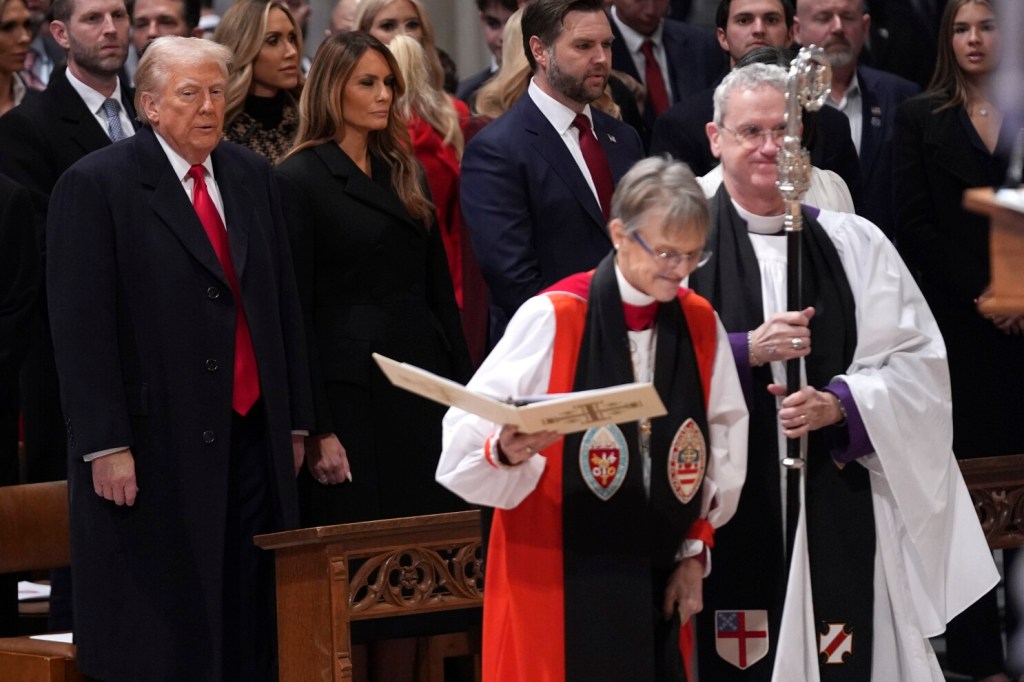
“Let me make one final plea, Mr. President. Millions have put their trust in you, and, as you told the nation yesterday, you have felt the providential hand of a loving God. In the name of our God, I ask you to have mercy upon the people in our country who are scared now… I ask you to have mercy, Mr. President, on those in our communities whose children fear that their parents will be taken away. And that you help those fleeing war zones and persecution in their own lands find compassion and welcome here. Our God teaches us to be merciful to the stranger, for we were all once strangers in this land. May God grant us the strength and courage to honor the dignity of every human being, to speak the truth to one another in love, and walk humbly with each other and our God for the good of all people. Good of all people in this nation and the world. Amen”
- Rev. Mariann Budde, January 21st 2025 from the National Cathedral in Washington
I opened this episode with Bonhoeffer’s quote about Cheap and Costly Grace. Bonhoeffer spoke of cheap grace as paying lip service to Christianity without living its demands. A quote loosely based on James 2 addresses this requirement of being a Christian: “Faith without works and works without faith is dead.” When Bonhoeffer mentions cheap grace, this is what he means. Going through the motions of being a Christian is not enough. You have to do the work. Budde’s message to Trump is about what “doing the work” would look like.
But there is another thing Bonhoeffer spoke about, which Budde emphasizes in her message to Trump: Forgiveness is required to be saved. All Christians MUST offer forgiveness to all sinners at all times. Bonhoeffer says: “<Costly Grace> is costly because it condemns sin, and grace because it justifies the sinner.”
Budde could have called Trump a disgrace and told him that his behavior was un-Christian. She could have told him he was “not her president” the way so many other progressives and liberals do. Instead, she opened up by making a plea to him. She acknowledged his belief that the providence of God saved his life from an assassin’s bullet. She leaned into this and said that if it is true, then here is an offer of forgiveness for all of your past trespasses and sins.
Her speech clarifies that all Trump has to do to receive God’s enormous gift of total forgiveness is to accept the forgiveness created by Jesus’ sacrifice and then live a life as Jesus commanded of his disciples: live humbly, serve the poor and vulnerable. These were the things God demonstrated to us through the life of his only earthly son. In case the message was still unclear, Budde explains it further. She says to be merciful to the stranger, to show compassion to the vulnerable, and to speak the truth to one another in love.
As I was saying this, you may have laughed at the idea that Trump would ever be capable of doing any of this. But that is not the point. Budde’s speech is an offer to Trump, sure. But it reminds the rest of us that a Christian’s job is to sincerely and truthfully offer everyone forgiveness at all times.
It is not a Christian’s job to forget people’s past behavior. Forgiveness is not justification. Forgiving only offers someone a door to walk through so that they can meet God and receive his rationale for the life they have chosen to live.
It is also not our job to ensure that people accept forgiveness. Receiving forgiveness requires being sorry for what you have done. Trump has lived a life with a core ideal of never apologizing. Offering Trump forgiveness is a futile effort, but it is still required of a true Christian.
Budde’s speech provides an example to the rest of us of what we should do. We should forgive everyone, even people like Trump, even when we know they won’t accept it. What the other person does with the offer of forgiveness is up to them. All you can control is your willingness to offer.
Matthew 6:12 says, “Forgive us our trespass as we forgive those who trespass against us. Deliver us not to evil. If you forgive those who trespass against you, then God will also forgive you. But if you do not forgive their trespasses, you will also not be forgiven.
John 13 tells the story of Jesus washing the disciples’ feet. It is memorable for the interaction between Peter and Jesus, where Peter initially objects to Jesus washing his feet. However, the passage also highlights that Jesus is aware of Judas’ betrayal of him, yet he washes his feet along with the others. The message is clear: If Jesus can forgive Judas, you can also forgive those who have wronged you.
I put Bonhoeffer and Budde together in this episode because hearing Budde’s speech the day after the inauguration reminded me of Bonhoeffer’s radio address shortly after Hitler became Chancellor. History has these rhyming moments. I also heard Molly Jong-Fast say in multiple interviews that Budde was going to end up at Guantanamo Bay for her speech to Trump and his goons. This also had an echo effect that reminded me of Bonhoeffer’s incarceration.
Many of the details are different, and I do not think America in 2025 is the same as Germany in the mid-1930s. But if I describe a clownish leader who takes over the country after a failed coup and begins threatening to build a large-scale prison system to house his enemies and lesser-status people for harming his country… you can see that it is hard to know which one is which. So, I am not discounting the similarities either.
In the end, I think that Bonhoeffer and Budde present a roadmap for the rest of us to follow in their words and actions. We should offer forgiveness, and we should live our lives to be of service to others. Service does not have to be grand gestures. Service means you do the little things to help when they present themselves. If we all forgive and support each other, then people like Trump cannot hold on to power. They only survive on the division and anger that divides us from each other.
 More Important Things
Leave a comment