Chapter 1: Red Summer
“We return from the slavery of uniform which the world’s madness demanded us to don to the freedom of civil garb. We stand again to look America squarely in the face and call a spade a spade. We sing: This country of ours, despite all its better souls have done and dreamed, is yet a shameful land.… We return. We return from fighting. We return fighting.” Civil Rights Leader, W.E.B. DuBois, 1919
“the American Negro returning from abroad would be our greatest medium in conveying <Communism> to America.” – President of the United States, Woodrow Wilson, 1919
About one million black people left the southern American states for northern industrialized states between 1914 and 1919. World War I was raging across Europe and America was mass producing a range of things that countries like France, England and Russia desperately needed for their fight against Germany. A black man could earn up to 3 times more in the north by working in a factory than he could doing agricultural work in the South.
For most of this period of migration things were peaceful. There was plenty of work thanks to demands from Europe for American goods. Northern cities actively recruited blacks from the South out of a desperation for labor to meet the demands they were facing.
But the seeds of 1919’s violence were being sown from 1915 – 1919 as well. The Ku Klux Klan, which had officially disbanded over 40 years early made its triumphant return in 1915 in response to the migration of blacks to the North. And Southern leaders expressed their concerns for the future of America if blacks experienced positivity and started getting ‘ideas’ about having a new place in American society.
QUOTE: “Impress the negro with the fact that he is defending the flag, inflate his untutored soul with military airs, teach him that it is his duty to keep the emblem of the Nation flying triumphantly in the air… and it is but a short step to the conclusion that his political rights must be respected.” END QUOTE Mississippi Senator James Vardaman, 1917
When the United States formally entered World War I black men were allowed to go to Europe as soldiers representing the US Army. What these black men found was that in Europe they were treated like full citizens of the world by the French and British. When World War I ended in 1919 these black men returned to America with hope of acceptance. What they found instead was that they were not received as heroes but rather as a threat to society that needed to be put down violently. This created a new tension for America. Black men began to push back against the Jim Crow laws and the status quo.
But even the slightest push by black men returning from Europe produced a massive and violent response by whites in America. “When you are accustomed to privilege, equality feels like oppression,” as the saying goes. The summer of 1919 is a great example of this saying and how powerful people can exploit this feeling to preserve the status quo and their own power.
In 1919 the work that had brought black men to the north had slowed down. Now these million black laborers that had migrated north were part of an excess of labor. Soldiers returning home, refugees that had come to America to escape Europe’s war, and blacks from the South all found themselves competing for work in cities like Chicago, Illinois and Omaha, Nebraska. The tension created by job scarcity created space for bad actors to fan the flames of old racial hatreds and suspicions.
Violence in the South towards blacks was a constant from the civil war and on in to 1919. Amid the normal simmer of violence a new strain also emerged to make 1919 an especially violent year in American history. The first known act of violence towards a black soldier was on March 12, 1919. Bud Johnson, an enlisted man who may have served in Europe, was attacked by a mob and hung from a tree in a town near Pensacola, Florida. The crowd repeatedly suspended him by the neck in to unconsciousness then would let him loose only to hang him again. They did this over and over again for several hours. When the crowd eventually tired of playing with their victim they smashed his head in to pieces so that members of the mob could keep pieces of Johnson’s skull as a souvenir. After his head was smashed the body was set on fire and left hanging from the tree.
Afterwords the white townspeople invented a story that Johnson had assaulted a white woman. But this story came later and is certainly false. There was also a story that he got in to a gun fight with a white man. This story, too, seems dubious. His dad had owed some people money and so it may be that he was killed over an unpaid debt. The truth is we don’t know much about why this event happened. The reality is that he was killed by a white mob for the crime of being black. Any other reason given would be on top of that fact.
In 1900 US Senator Benjamin Tillman said QUOTE: “We <whites> of the South have never recognized the right of the negro to govern white men, and we never will. We have never believed him to be the equal of the white man, and we will not submit to his gratifying his lust on our wives and daughters without lynching him.” END QUOTE
Lynching was not limited to black people. During the California Gold Rush (1848 – 1851) white miners lynched and killed at least 160 Mexicans and other Latino prospectors. In 1871 a mob of 500 people went in to the then-small Chinese community of Los Angeles and murdered 19 Chinese people in response to the death of a police officer who had been trying to intervene in a dispute between to Chinese immigrants. In 1891 a mob in New Orleans rounded up 11 Italian immigrants and killed them on suspicion that they had killed a police officer.
In the New Orleans case the 11 Italians were part of the Matranga Crime Family, one of the oldest continuously operating crime families in North America. These men probably were responsible for the officer’s death. This doesn’t mean they deserved to be lynched but it does mean that the court case that couldn’t convict any of these 11 men may not have been on the level.
The Matranga Crime Family is so engrained in American society that they are the family who people first used the term “Mafia” to describe. In the aftermath of this lynching the crime bosses of New Orleans began working with the police to try to ensure the boys in blues’ safety as the mafia conducted business in Louisiana.
But the lynching of non-blacks are outliers and not the norm. Lynching was overwhelmingly an activity of white people inflicting violence on black people. From 1883 to 1941 there were about 4,500 lynchings in the US. 4,400 were men and only 100 were women. About 3,300, or 75% of all lynchings in this period, were of black people.
These statistics tell us that if lynching had remained solely in the South in 1919 then the year probably would not stand out from other years. But 1919 is known as the Red Summer due to the extremes of violence that occurred. The violence that makes this year stand out occurred in Northern cities, where lynchings were pretty uncommon outside of 1919.
The racial tensions moved north at the end of May when two white soldiers were arrested for fighting in New London, Connecticut. These two white soldiers made claims to police that their bad behavior was brought on by violent black soldiers staying at the nearby Hotel Bristol. When word got out that these two white soldiers may have been attacked by black soldiers a mob began to form at the Hotel. Eventually as many as 5,000 people surrounded the hotel. The crowd beat up the mostly black staff of the hotel and attacked several of the black soldiers found inside. There was plenty of violence in this first northern incident, but no one died.
Afterwords the federal government blamed the violence entirely on the black soldiers. Blacks cause panic with their behavior and presence among whites so any violence was because blacks provoked it somehow. Headlines describing the event went like this one: “Negro Sailors Attack Whites at New London!” It’s an interesting description of a scene where 5,000 white people trapped a few dozen black people inside a building and then attacked them.
This event would be followed by dozens more riots, lynchings, and other clashes across the United States. The statistics on the violence are hard to know. Officially lynching deaths in 1919 totalled 78. But hundreds of other people were killed across the US in non-lynching violent events. Thousands of people had their homes destroyed by mobs, thousands more suffered major injuries, and the fear and threats caused damage to people that can’t be measured by the statistics we have available to us today.
Violence in the north hit its peak between July 27th and August 3rd in Chicago after a black teenager accidentally swam in to a “white’s only” section of a swimming area. For his transgression he was stoned with rocks and ultimately drowned. When white police protected the person who killed this black child a riot broke out. In the end 38 people died and another 500-plus people were injured.
In one of the most hypocritical things I’ve ever read President Woodrow Wilson said of the riot in Chicago that it was prompted by whites and that the people of Chicago should do a better job promoting racial harmony. Wilson, who had purged the federal government of nearly all black employees because they were too child-like in his opinion to handle responsibility, did not seem to change course on his decisions. He was capable of scolding Chicago for its behavior; but was incapable of any self-reflection on the racist and bigoted decisions he had made as President.
I want to close the first section of this episode with a quote from Martin Luther King Jr. I think it is interesting to consider his words from 1968 in the middle of a story from 1919 as we grapple with many of the same problem in 2024. We are still waiting for the reckoning that King speaks of. Anyway here are King’s words regarding the riots in America that people were grappling with in his lifetime:
“I wanted to say something about the fact that we have lived over these last two or three summers with agony and we have seen our cities going up in flames. And I would be the first to say that I am still committed to militant, powerful, massive, non-violence as the most potent weapon in grappling with the problem from a direct-action point of view.
“I’m absolutely convinced that a riot merely intensifies the fears of the white community while relieving the guilt. And I feel that we must always work with an effective, powerful weapon and method that brings about tangible results.
“But it is not enough for me to stand before you tonight and condemn riots. It would be morally irresponsible for me to do that without, at the same time, condemning the contingent, intolerable conditions that exist in our society. These conditions are the things that cause individuals to feel that they have no other alternative than to engage in violent rebellions to get attention.
And I must say tonight that a riot is the language of the unheard.
And what is it America has failed to hear? It has failed to hear that the plight of the negro poor has worsened over the last twelve or fifteen years. It has failed to hear that the promises of freedom and justice have not been met. And it has failed to hear that large segments of white society are more concerned about tranquility and the status quo than about justice and humanity.
Now every year about this time, our newspapers, and our televisions, and people generally, start talking about the long hot summer ahead. What always bothers me is that the long hot summer has always been preceded by a long cold winter. And the great problem is that the nation has not used its winters creatively enough to develop the program, to develop the kind of massive acts of concern that will bring about a solution to the problem.
And so we must still face the fact that our nation’s summers of riots are caused by our nations winters of delay. As long as justice is post-poned we always stand on the verge of these darker nights of social disruption. The question now is whether America is prepared to do something massively, affirmatively, and forthrightly about the great problem we face, in the area of race, and the problem which can bring the curtain of doom down on American civilization if it is not solved… END QUOTE – Martin Luther King Jr, March 14, 1968.
Chapter 2 – Omaha, 1919: Astroturfing a Race Riot
Martin Luther King spoke of the riot as the language of the unheard. This is true if the riot is a real expression of a group’s prolonged frustrations. Riots like the ones in the mid-1960’s, or of the American colonists against English oppression are an expression of the masses against leaders who aren’t responding to the mobs needs or demands. These kind of mob revolts have brought about major events in history. The French and American Revolutions, The toppling of the Russian czar. And so on.
But what about a riot that isn’t natural. What if the riot is “cooked up” by leaders in bad faith? How do the rest of us know the difference?
In 2009 the Tea Party Movement began appearing around the country at rallies. Right away reporters and other onlookers began to notice some strange things about these Tea Party events. The same signs, slogans, and intricate costumes would appear in city after city on totally different people. When asked some people would talk about being encouraged to hold these signs or wear this costume. As reporters dug in to the Tea Party Movement it became clear that major tobacco and oil companies, as well as a powerful syndicate of billionaires, known as the Koch Donor Network, were funding much of the activity of the Tea Party. Far from a grass roots movement this one appeared to be paid actors pretending to be aggrieved.
The Tea Party is a complicated phenomenon because there really were people at local levels who were frustrated by real things in their life. But the signs were provided by a tobacco company. The Koch Donor Network wanted people dressed like 17th century Americans. Even the name Tea Party was a product-tested name that resulted from a major think-tank’s efforts to create a movement.
This is what is known as “Astroturfing”. Astroturf is a fake substance that was popular in sports venues 50 years or more ago. It looked like grass and was easier to maintain so it covered many baseball and football fields across America. By the 1980’s it was clear that Astroturf was incredibly harmful to the athletes who played on it. It wrecked knees and backs and may have caused cancer. It ended many careers early. Today most stadiums have returned to natural grass or use other hybrid compounds like a thing called “field turf” to cover their fields.
Anyway, an Astroturf campaign in politics is one where powerful people do things to create activity amongst people that appears to be natural but is really funded from the top. We started this episode with the race riots and lynchings that were spreading across the United States in 1919. One of those events is the riot in Omaha, Nebraska. But I think it is important to understand the concept of Astroturfing before looking at this event.
Ok, on with the story….
“The most daring attack on a white woman ever perpetrated in Omaha, the most recent act in a series of violent offenses conducted by the Negro on Caucasian females in the city, occurred one block south of Bancroft Street near Scenic Avenue in Gibson two nights ago. Pretty little Agnes Loebeck was assaulted by a negro she identified as William Brown while returning home in company with Milton Hoffmann, her fiancée, a cripple and decorated war veteran.” The Omaha Bee, September 27, 1919.
Milton Hoffman, mentioned in the above article as a war veteran, was actually a former bareknuckle boxer from New Orleans. He worked for a man named Tom Dennison and was a relative of the prominent Rosewater family of Omaha. While Hoffman was described as a “decorated war veteran” from his time in World War 1, I could not find details of what made him decorated and it is very possible that none of that story about him is true given that those details appeared in a paper called The Omaha Bee, which made a habit of lying in pursuit of the stories they preferred to tell.
Agnes Loebeck is listed in the article as Hoffman’s fiancé. Here again we cannot trust the Bee’s description. Loebeck was one of 7 children born to first generation German immigrants. To help the family make ends meet she worked as a prostitute. There is no evidence that she was Hoffman’s fiancé at the time, though they did get married a few years later. It is more likely that she was paid to be with him that night in her professional capacity, though it is possible they were more than just client-prostitute at the time the story ran in the Bee.
Agnes was part of a booming prostitution industry in Omaha at the time. There were about 2,500 active prostitutes in Omaha in 1919 serving the roughly 200,000 people who lived there. All 2,500 prostitutes in the Omaha area worked for Tom Dennison in some way or another. There’s that name again: Tom Dennison.
The story of Hoffman and Loebeck told was a recurring one for police in Omaha that year. In 1919 the Omaha police received dozens of reports claiming violence perpetrated by black men towards white women. From January through August of 1919 Omaha Police arrested over 100 different black men on charges of assaulting white women. None of these black men were found to have done anything criminal and all were eventually released.
There was a rash of crime sweeping through Omaha in 1919, however. And this crime wave had a pattern to it. A white man dressed in blackface would perpetrate a crime, anonymous people would report some innocent black man to the police, the Daily Bee would blare an incendiary headline about scary black people and the incompetent mayor and chief of police who aren’t keeping good white people safe from dangerous blacks… rinse repeat.
Over and over again the police would have to let the black men they arrested go free because of a lack of evidence. One other feature of this crime wave was that many witnesses claimed to know exactly who these men in blackface were: They were employees of Tom Dennison, the man who was actively trying to spark a race riot in the city. Ok 3rd time’s a charm… who was Tom Dennison?
Tom Dennison was born in Iowa in 1858 and his parents moved to Nebraska in 1860 when he was 2. As a young man he ventured west to search for gold in California. He quickly abandoned mining and pivoted to gambling, saloon keeping, alcohol sales, and he even committed several robberies. Through this string of extra-legal and illegal activities he accumulated about $75,000 dollars in wealth, or about 3 million dollars in 2024 money.
In 1892 Dennison returned to Omaha with this sizeable war chest and decided to set up shop as the King Gambler of Omaha. Omaha was thought to be a city with few rules. It was a city that was open for a crime lord to come in and set up shop. Dennison was just the man for the job.
Dennison had no interest in holding public office or anything like that. He wanted to run gambling, prostitution and alcohol in Omaha and so he began funneling cash from his businesses in to the pockets of politicians who would look the other way on him and his activities. A very large part of the population of Omaha ended up working for Dennison in one way or another by 1900. As such he could rally large get-out-the-vote initiatives for his preferred candidates. From 1906 to 1930 Dennison’s candidate for Mayor won 8 out of 9 elections.
In the 1890s and early 1900s one of the ways Dennison kept the city under his control was by funneling his preferred messages through one of his closest allies, Edward Rosewater. Rosewater was the owner of the Daily Bee newspaper.
Rosewater was closely aligned politically with Dennison in the Republican Party and so they worked together to fund and message on behalf of their preferred candidates and issues. In 1906 Rosewater and Dennison had a falling out when their Republican Party took a progressive turn. They agreed they could not support the new progressive initiatives or candidates; but they disagreed on a course going forward. Their falling out was complete when Dennison decided to support a Democrat named James “Cowboy” Dahlman for Mayor.
Dahlman was willing to let Dennison operate his businesses outside the law so long as Dennison agreed to let Dahlman implement his agenda in the rest of Omaha. With Dennison’s substantial support beginning in 1906 Dahlman would be Mayor for most of the next 25 years.
Shortly after Dennison and Rosewater had a falling out in 1906, Edward Rosewater died. I couldn’t find any suggestion of foul play… but it is an extreme bit of good fortune (perhaps too good) that shortly after Dennison and Rosewater had a falling out Rosewater had the courtesy to drop dead in his office. It is an even greater bit of fortune (again, perhaps too good) that Rosewater’s son, Victor Rosewater became the new owner of the Bee. Victor, as luck would have it, was fully on board with Dennison in his support of the Dahlman Mayoral ticket.
Victor Rosewater was a student of what is known as “Yellow Journalism”, which he brought to the new and improved Omaha Bee. Yellow Journalism is defined as “the practice of reporting the editor’s interpretation of the news rather than objective journalism. The information reported is usually inaccurate or biased, and the language and tone is intended to arouse passions”
Dennison and Dahlman had a version of history they wanted people to hear and Victor Rosewater was more than happening to splash that message across the front page of his newspaper for his friends.
I mentioned that Dahlman won 8 of 9 elections. The one he lost was in 1918 when he lost the Mayoral race to a progressive reformer named Edward P Smith. Smith ran on a platform to clean up the corruption in Omaha. He specifically promised to bring an end to Dennison’s mobster-style hold on the city. One of his first acts as mayor was to appoint a progressive reformer named J. Dean Ringer as the new Omaha Police Commissioner. The new Commissioner and Mayor were going to crack down on Dennison’s illegal activities.
Before the new Mayor could make good on his promises, Rosewater and Dennison decided that these two reformers needed to be crushed. To crush them they hatched a plan to convince the city of Omaha that a crime wave was happening. They would convince Omahans that their city was going to hell under the weight of a flood of blacks coming from the south. The Daily Bee headlines of 1919 would sound familiar to us since they were very much like the words of a modern fear-mongerer in our midst: “…they’re not sending their best. They’re sending people that have lots of problems, and they’re bringing those problems with <them>. They’re bringing drugs. They’re bringing crime. They’re rapists. And some, I assume, are good people.”
Since the black population of Omaha wasn’t actually committing a wave of crime Dennison decided to send his men out in blackface to do it. Rosewater dutifully reported on these crimes in his paper with incendiary headlines.
“The Bee carried vivid descriptions of the arrest of blacks charged in these incidents. When police and prosecutors could not convict any of those arrested, some Omaha citizens became even more critical of the police department and the reformer Smith’s administration. In early June, the Bee published an article about a young white girl in Council Bluffs who said she was robbed, throttled, and assaulted by a black male. The Bee sometimes printed editorials on the front page of the newspaper, assailing police commissioner Ringer for practicing tyranny and abuse and complained that “a ‘carnival of crime’ is being visited upon the city, with assaults, robbery, and violence the consequences of incompetent police unable to safeguard citizens.” END QUOTE
And then on September 1, 1919 Omaha police raided a poker game at a downtown Omaha hotel. In the chaos police shot an employee of the hotel, a young black man named Eugene Scott, to death. Police claimed he was running away but my guess is that if we had video of this like we often do of these types of police incidents today it would tell an entirely different story. Witnesses at the time described police behavior related to Scott’s death as “disgraceful and incompetent.” The Omaha Bee had a different view. They called Scott’s death “a crowning achievement for the Omaha Police Department.”
By September, 1919 this sustained campaign to stoke fear and violence had not produced the results that Dennison wanted. Omaha was a city on edge but had not descended in to violence. September would start with the murder of one young black man by police. But by the end of the month Dennison would have his prayers answered. The city would erupt in to chaos and violence. The whole city would have blood on its hands by the end of September.
To get to this bloody and violent result Dennison hired two people that worked for him: Agnes Loebeck and Milton Hoffman. Milton Hoffman was a elevator repair man (a business owned by Dennison) and Hoffman worked “tough guy” jobs on the side for Dennison’s mob organization. If you’ve ever seen the Sopranos or any mob movie you can picture a guy like Hoffman from those movies.
Anyway, Dennison hired Hoffman and Loebeck to go on a date. He probably told them to have a nice time. I would guess he gave them a stack of cash and even paid for their night out.
He sent another one of his goons to find them on the street after their date. This goon showed up in blackface and may have even roughed Loebeck and Hoffman up a bit just in case there were any witnesses. They had to make it look good, afterall. After the incident police took a report from the two supposed victims and arrested the person they identified as their attacker.
Two days after the incident was reported The Daily Bee published the article I opened the chapter with. No one is going to riot over an attack on a mob tough guy and a prostitute so the Bee described them as “Pretty little Agnes Loebeck and Milton Hoffmann, her fiancée, a cripple and decorated war veteran”
To ensure the city got whipped up in to a mob over this event Dennison paid dozens of people to go door-to-door fomenting a riot. I mentioned before that Dennison had an impressive get-out-the-vote machine. He used this machine to get people out of their homes and over to the Loebeck residence to support this woman who had been attacked.
The mob was told they would catch Brown at the Loebeck house as the police were having Agnes identify him. There they could grab him and lynch him. The crowd didn’t arrive in time to grab Brown there so they eventually moved downtown to the county courthouse, where the jail that held Brown was located.
What started as 40 or so people at the Loebeck house grew to a crowd of over 10,000 at the court house within a few hours. A recurring theme of riots throughout 1919 was that police would respond to mobs of white people by arresting the black people in town and clearing them out of town.
Omaha did this too. Police conducted a sweep of the city and arrested 45 or so black men on no grounds of doing anything suspicious. About half of these men were taken to a train station and forced to leave town.
By day 2, September 28th, the crowd at the court house swelled to 20,000 people by 5pm. In the evening conflict between police and rioters escalated. Before 5pm the police on guard had reported to their superiors that the large crowd was not a threat and would soon disperse. But about 15 minutes after they reported that all was well the crowd erupted in to violence. The crowd began throwing bricks at the police and the courthouse. They started fires. They surged towards the entrances. The police responded by spraying hoses at the crowd. Police used their clubs to beat several of the rioters.
At 6pm The Chief of Police tried to speak to the crowd and calm them down. The crowd booed and hissed and threw things at him until he gave up and retreated in to the courthouse. By now someone had dispersed thousands of guns in to the crowd. The sounds of gun fire filled the air as bullets whizzed around downtown Omaha.
At 7pm a few leaders of the mob returned from a nearby gas station with bottles full of gasoline. They lit these bottles on fire and began throwing them at the courthouse building; causing the whole block to go up in flames. Soon after the fires erupted the mob rushed in to the building trying to find William Brown.
In the chaos of this first surge in to the courthouse a 16 year old white boy named Louis Young was killed while climbing the stairs inside the building. One of his fellow mob members apparently accidentally shot him in the stomach. He would bleed to death in a stairwell.
A block from the courthouse a white man named James Hiykel was shot to death. We don’t know why or by whom. It may have been an accident in the chaos or it may have been a crime of opportunity. We will never know.
In addition to these two deaths there were dozens of black men around the city beaten and tortured by various mobs of marauding white people. People in the crowd were trampled and injured by the swaying and charging masses as well. In addition, dozens of police officers were injured trying to protect the courthouse and keep the peace.
At about 11pm the Mayor, Ed Smith, emerged from the courthouse to try to talk to the mob. Someone in the crowd spotted the mayor and shouted “There’s the mayor! He has a gun! He shot me! Mayor Smith shot me!” Before the mayor could speak the crowd descended on him. Someone hit him in the head with a baseball bat. Another rioter put a noose around his neck and the rioters dragged him from the courthouse to a nearby tree.
Omaha Mayor Ed Smith was strung up from a tree to be lynched and killed. But a group of police officers drove their vehicle in to the crowd that was attempting to hang Mayor Smith. One officer cut him down from the tree and the officers, with the mayor, sped away from the violent scene. The mayor was badly injured but would regain consciousness several days later and would eventually recover. Family members of the mayor said that he had panic attacks stemming from the riot that impacted him for the rest of his life. He did not seek re-election after his one term as mayor and retired from political life.
The rioters continued to harass the police and the courthouse through the night. Police inside the courthouse called their wives and loved-ones to tell them goodbye, assuming they would soon be killed by the mob. Eventually William Brown was handed over to the mob in exchange for the lives of everyone else trapped in the courthouse.
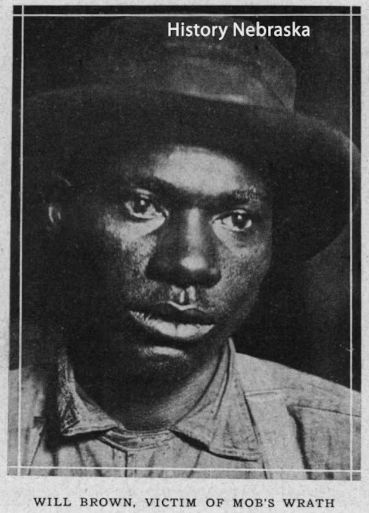
The mob beat and tortured Brown in the courthouse. Eventually they dragged him out of the badly burned and damaged courthouse and took him a few blocks away to a telephone pole where he was strung up. The mob spent an hour so taking turns shooting at the body with their guns and rifles. Eventually the body was cut down from the pole, tied to the bumper of a car, and dragged through downtown Omaha.
Eventually the mob tired of dragging the body. Brown’s body was doused in gasoline and set on fire. His charred remains would be dragged and carried around downtown Omaha for several more hours by the hooting and proud crowd of white Omaha residents.
The riot ended in the early morning when the Army arrived in the city to restore order. The army would remain in Omaha under an informal, then formal, declaration of Martial Law that would continue in to October.
PAUSE
In April 1921 Mayor Ed Smith gave a speech at the Omaha Auditorium where he said that he did not believe that Agnes Loebeck had been attacked. She made the whole thing up. Agnes and Milton Hoffman married and moved to Denver, with a substantial financial gift from Tom Dennison to do so.
120 indictments were issued in relation to the riot. In the end only a handful of people were convicted for their actions in the riot. In 1921 Dennison’s preferred mayor got his job back. Jim “Cowboy” Dahlman dismissed all charges pending against anyone related to the riot as one of his first acts back on the job as mayor.
In the years following the riot it emerged that Will Brown had hired Agnes Loebeck as a prostitute at least once. She was unhappy with him for some reason and accused him because she wanted revenge on him for being a bad client. I could not find any record of what he did to upset her.
Will Brown shoveled coal for a living. After he was arrested police noted that he had chronic rheumatism and walked with a pronounced limp. The police said he was constantly hunched over and was always ringing his hands due to the extreme pain he was in. He had spent a very hard life working in the meat packing plants and lumberyards of early Omaha. Sadly I could not find more on his life before the incident that cost him his life.
Hoffman and Loebeck claimed that Brown had overpowered the two of them with his size and strength. He was able to keep Hoffman, a bareknuckle boxer and alleged war hero, at gun point while he dragged Loebeck by the hair, stripped her of her clothes, and then sexually assaulted her. The description of him by the police versus the one given of him by Loebeck and Hoffman seem to be of two utterly different people.
A QUOTE from a Western Carolina Historical Article: “Several men who expressed their thoughts after the Omaha race riot cited this exact reason as the underlying cause of the violence. An unknown mob leader spoke to the Daily Bee and claimed the event was carefully planned in detail. He stated that “the assault had been the topic of conversation for days in his neighborhood.” He further explained that someone was behind the event and spent a lot of money. Early on the morning of September 27th, liquor was distributed to the white men of Omaha, and they were transported by taxicabs to the courthouse where they were handed armaments.”
“Bystander J.J. Friedman observed the planned execution first hand. He expressed that he saw a blond burly fellow directing the actions of the mob. The observed orchestration of racialized mob violence speaks to the desire to destroy black masculinity in the name of political gain. Dennison, who notably controlled Omaha’s underground activities, maintained access to the necessary tools (i.e., liquor and guns) to escalate the instability felt by white men into an all-out race riot. Fueled by whiskey and the belief that their masculine hegemony was under attack, the men of Omaha proceeded to pursue gender dominance by destroying the political center of their city and ultimately murdering William Brown.” END QUOTE
In a 1982 article, Henry Welch shared his father’s account, his father was the deputy sheriff the night of Loebeck’s alleged assault. Welch claimed that when he approached Loebeck’s home, he looked in the window and witnessed Loebeck cleaning her floor. Upon knocking, the officer had to wait a substantial amount of time before Loebeck told them to come in. When the officer entered Loebeck’s home her demeanor changed. Welch reported that she was lying on the couch with a big towel wrapped around her head. The deputy sheriff divulged that he believed the woman was faking it.
To stop the rioters in Omaha, the Army came in to the city and declared martial law. By the time of the Omaha riot it had become standard operating procedure for the federal forces to implement a “red line” district for black residence to live in as part of peace-keeping measures. The theory of maintaining peace between blacks and whites in 1910’s America was that black people needed to be contained. The presence of black people in places designated for white people caused inflamed tensions that led to violence. Rather than make white people behave better the federal government would spend the next 40 or so years red lining black people in to confined districts of the cities they lived in.
In 2024 there are about 1,950,000 people living in Nebraska. Of that total population about 11% or 125,000 people were demographically described in the most recent census as “Black or African American alone or in combination.” Of that 125,000 people about 85,000 of them live in one concentrated area in the Southeastern corner of the state, in and around the city of Omaha.
In 2024 about 68% of all black people in Nebraska still live generally inside the borders drawn to restrict them as a result of the 1919 riot. It is tempting to hear a story of a riot from more than a century ago and think it has nothing to do with us today. But the systems of oppression haven’t left us, they have just been woven so seamlessly in to the structures of our society and culture that we often can’t see they are there anymore.
 More Important Things
Leave a comment