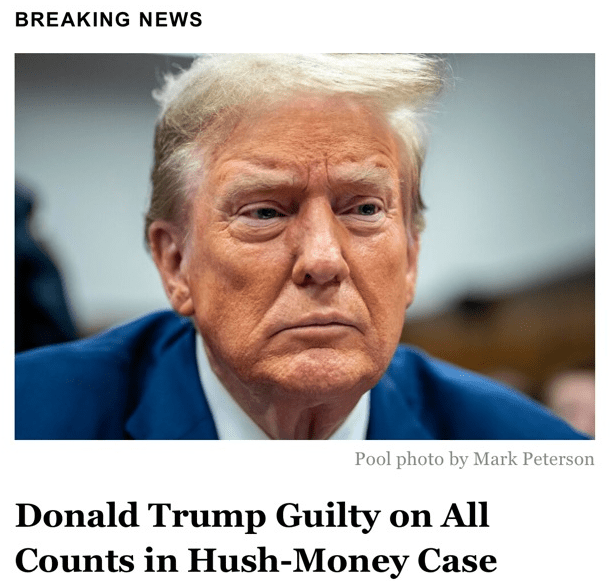
Hello and welcome to More Important Things. This weeks’ more important thing is Democracy. A fun topic that will include a bunch of stuff about recently convicted felon, Donald Trump. In fact, we start with four quotes about Former President Trump’s quest to find those illegal votes:
“The Wisconsin recount is not about finding mistakes in the count, it is about finding people who have voted illegally, and that case will be brought after the recount is over, on Monday or Tuesday,” Trump tweeted on Saturday. “We have found many illegal votes. Stay tuned!”
- Donald Trump, November 2020
President Donald Trump asserted in a private meeting with congressional leaders Monday night that he would have won the popular vote in the 2016 election if 3 million to 5 million immigrants living in the country illegally hadn’t voted.
- Donald Trump2017
“Tens of thousands of votes were illegally received after 8 P.M. on Tuesday, Election Day,” the President tweeted, further claiming these votes are “totally and easily changing the results in Pennsylvania and certain other razor thin states.”
- Donald Trump, November, 2020
“That’s why they are allowing these people to come in — people that don’t speak our language — they are signing them up to vote. And I believe that’s why you are having millions of people pour into our country and it could very well affect the next election. That’s why they are doing it.”
- Donald Trump, February, 2024
Chapter 1: We Hope the Hicks Don’t Vote
If you simplify the story of Trump’s claim and ask who is ‘legal’ and who is ‘illegal’ then a Pew Research study from 2021 can be clarifying. It shows that white men voted for Trump in 2020 by a margin of 57% to 40%. In other words, if there hadn’t been all these quote unquote illegal votes, where illegal votes are the votes of women and non-whites then Trump would have won the 2020 election in a landslide.
A common talking point among political pundits in the 2020’s is that we are in danger of losing our democracy. Usually this threat is what will happen if Donald Trump becomes president again. But Republican-based media also talks about this in terms of Democrats trying to turn America Socialist, or whatever. The threat that party x is going to end democracy is harder when that party is in power and isn’t ending democracy and easier when they are not in power. So right now it’s mostly pundits from the left talking about Trump ending Democracy if he comes back.
But what does it mean to be a democracy? Is it just voting? If you vote in the United States you do so on a few levels: Federal, State, maybe County, and City. You may vote even more locally than that, like in a neighborhood association. I’m mainly focused on Federal voting in this episode.
At the Federal there are three branches of government: The Legislative, The Executive, and the Judicial branch. There are thousands of people who work in these branches. These people are either hired like you would be for any job, appointed by the legislative or executive branches, or elected by their constituents.
- The Legislative branch is the House of Representatives, with 538 members, and the Senate, with 100 members.
- The Executive Branch is the President and Vice-President.
- The Judicial Branch for our purposes is the 9 Supreme Court Justices but there are also 881 other Federal judges that serve on District Courts, Appeals Courts, and a couple other courts which mostly have lifetime appointments.
If you believe that America is a Democracy then part of why you think so is because in these three branches we elect 640 people to their positions by voting for them. But if you consider that a little further… At any given time you only have a say in 4 of those 640 people. You personally will have an opportunity to vote for President, the one member of the House of Representatives that represents your district, and the two Senators that represent your state. In a single election the most federal office holders you can vote for is 3 because Senators serve six year terms and states usually stagger them so you vote for one or the other seat every three years. 4 out of 640 is less than 0.6%. Your individual influence on federal politics is nearly zero.
It’s even smaller if you live in a solidly Republican or solidly Democrat district in a state that matches the makeup of your district. There are 5.3 million registered Republicans in California, the most of any of the 50 states. A registered Republican in California will likely never matter in any election for the rest of their lives for the 2 California Senate seats or in the vote for President.
There are currently 40 Democrats and 12 Republicans holding the 52 seats in the House of Representatives from California. When states are run by a substantial majority of one party or the other they pack House Districts as much as they can to minimize the other parties influence. California hasn’t gone as far as some states do with this. Republicans make up a little over 25% of the electorate but get 1 to 2 fewer house seats than that population might expect to have.
To further diminish the idea that we are a democracy we don’t have any access to the Judicial Branch. Those 890 federal office holders are all nominated by the President and approved by the Senate. Once approved they never have to face voters. The only way for them to be removed against their wishes is by death or impeachment.
Even the President isn’t a direct election. We’ve added the electoral college as a step that doesn’t guarantee the person with the most votes will win. 5 Presidents have been elected despite not getting a majority of votes: Rutherford B Hayes in 1876, William Henry Harrison in 1888, George Bush in 2000, and Donald Trump in 2016. The fifth one is John Quincy Adams in 1824. He didn’t win the popular vote or the electoral college yet became president anyway. But that’s a story for a different day.
A modern problem that needs to be addressed is that Democrats have won the popular vote in every election except one, 2004, since 1992. Despite winning 7 of 8 popular votes Democrats have only ‘won’ 5 of 8 elections. This problem is made worse because the Supreme Court is made of 9 Justices, 6 of whom were appointed to the court by Presidents who lost the popular vote. Voters don’t have direct access to 2 of the 3 branches of the Federal Government and those two branches are become less and less representative of the majority of Americans.
Both of our two parties become a problem for voters when the most vote-getter doesn’t win. For Republicans it means they don’t have to listen to the majority of their constituents. It allows them to hew to the more extreme ends of their party. For Democrats it discourages them to produce great candidates. The Democrats’ pitch has become that we all have to vote for them, regardless of what they do, because the alternative is rule by some small slice of extremist right-wingers. Clearing the low bar that you are better than the extremists is not a prize-worthy accomplishment.
To really get in to the weeds Democracy is two Greek words: Demos which means people. And kratos which means to rule. So Democracy literally means “rule by the people.” An actual democracy would be a system where all eligible citizens come together and hold a vote on any topic that needs a decision. But America never does that.
What we do is a thing called Representative Democracy. What that means is that we elect people; the president, the senate and the house. Those people then go off to whatever body they’ve been elected to and then they vote on stuff as our representatives. At the national level we don’t have any mechanism for direct democracy.
Other peer countries to the US have direct democracy. Great Britain has a direct democracy tool called a Referendum. Most Americans are familiar with this tool of British democracy because Britain used it to leave the European Union, the EU, through what is known as “Brexit” in 2016. The conundrum of Brexit is that the people in the US who say they are defending democracy from Trump are also people who are likely horrified by Brexit. So, with Brexit in mind, is more democracy a good thing?
Brexit seems to be a story where letting the people decide backfired on the country. The number one google search in Great Britain the day after they voted to leave the EU was “what is Brexit?” Not a great sign for democracy.
Speaking of Britain. Are they a democracy? I started by mentioning today’s political pundit classes favorite battle cry: If Trump becomes President again he will end democracy. The British peer to our President is their Prime Minister. The Prime Minister is not an elected office. Basically when a political party, or coalition of parties, secures a majority in the British Parliament they hold a vote for Prime Minister amongst only their elected members of Parliament. This is a slice of a slice of people voting for their President-equivalent role and not a popular vote, yet we think of Britain as a democracy.
Britain also still has a monarchy. The American Founders were clear that the opposite of democracy was monarchy. So Britain has a monarchy and doesn’t use a popular vote to elect its Prime Minister and yet it is a democracy.
Russia does hold regular votes for president. Vladimir Putin wins those elections every time. Even further the one time he had a legitimate rival in elections was when a man named Alexei Navalny tried to run against him. Putin had Navalny kicked out of the country, then poisoned, then arrested, then convicted in a show trial, and ultimately Putin had Navalny killed. I don’t think anyone would call Russia under Putin a democracy. But they do have voting and elections.
Russia is not a democracy because of a phrase that goes back hundreds of years: “free and fair elections.” So maybe that is what it takes to be a democracy. Ok but does America HAVE free and fair elections? If you are under 18 you don’t get to vote, most convicted felons don’t get to vote, there is a whole list of reasons people can’t vote. There is also a whole bunch of situations that make it hard for people to vote even when they are eligible to do so.
In 2020 according to Pew Research about 66% of eligible voters actually voted for President. It was the highest turnout since at least 1900. Most years less than 50% of eligible voters even cast a ballot for president. Even fewer people vote in non-presidential election years. Some people probably don’t vote because it isn’t important to them. But it is easy to understand that many people have to work, have children, have other life events going on that make it too hard to vote. There are millions of Americans who probably would vote if they had the time and means to do so.
A real democracy would make election day a national holiday, would create rules that require employers to give their workers time off to vote, and maybe even does things like offer a tax credit to anyone who votes. The philosopher John Dewey once said: “the solution to the ills of Democracy is more democracy.”
A couple more thoughts on “free and fair”:
Until 1971 the voting age in the United States was 21. The 26th Amendment lowered the age to 18. It wasn’t the only reason, but the most compelling reason was that at the time a person could be drafted to serve in the military at 18 but could not vote until 21. Those three years where the government could demand your service but you could not vote on the people who demanded your service seemed counter-intuitive.
The movement to lower the voting age started in the 1940s. Most activists pushed to lower the age to 16, not 18. 18 was settled on because that draft argument was compelling in its time. But there is nothing magical about 18. It’s not like at 17 you are an idiot who is not capable of having an opinion about politics but suddenly do know better a year later at 18.
We don’t apply a civic competency and awareness requirement to anyone 18 or over. For example, we don’t take the voting franchise away from people on anti-pyschotic medications. We don’t revoke the voting rights of elderly people with dementia or Alzheimer’s Disease. You might think we should take voting away from those people but we don’t. And since we don’t it then makes me wonder why we don’t let anyone able to hold a pencil and fill in a scantron circle vote.
If a 5 year old has the basic skills to go into a booth, read the forms, and fill out a ballot I think they should be able to vote. You may think their awareness of politics isn’t sufficient to be counted on to vote. But I would counter that view by saying that in March of 2024 a New York Times poll showed that 17% of registered voters blame Biden, not Trump, for ending Roe v Wade. It is hard to convince me that a five year old’s vote is less valid than these 17% of the electorate who blame the wrong presidential candidate for ending Roe. If you believe that democracy must be free and fair then it only makes logical sense that every citizen, regardless of age, should be allowed to vote.
Here is another free-and-fair question: Why do we disenfranchise people convicted of crimes? What does robbery or dealing drugs, or even murdering someone have to do with your opinion about who should be president? Earlier I mentioned that the compelling argument for lowering the voting age was that people between 18 and 20 were drafted in to the grips of the government but didn’t have a say about the makeup of that government. Today you could make an argument that people in prison have more interest in their politicians than any other demographic group.
Our history of disenfranchising criminals is complicated. There were a few laws here and there in the US prior to the Civil War. After the Civil War ended in 1868 two initiatives were set in motion. The first was a thing called “The Black Codes.” There were Black Codes going back to at least the 1700s. But after 1870 the Black Codes were sets of laws specifically designed to criminalize doing things while black. So if you were black and around white people, particularly white women, that was a crime. If you lingered on a street too long while black that was vagrancy. You get the idea.
The Black Codes were ramped up to attach criminality to doing anything while black. Disenfranchisement of criminals comes up along side these new Black Codes as a really slick way to maintain white power in a society full of newly freed black former slaves. Arrest every black person you can find, run them through an all-white criminal system (white judges, white juries, white cops…) convict them, and then make a rule so anyone who is a criminal is ineligible to vote. This allows people to claim they aren’t racist, they just believe that only law-abiding citizens should vote.
Today prisoners have very little say about where they are being incarcerated. Interestingly prisoners count as population for things like creating districts. Today there are 158 privately owned prisons. This is only 8% of the prison population but it is a growing sector in US prisons. It is conceivable that a bad actor who wants to change the makeup of house districts could open prisons in an area where they want to create more districts. They could move power to certain cohorts by bringing in an incarcerated population who will count towards the electorate without being able to cast a vote.
It isn’t just private prisons. A governor and state legislature could manipulate the population makeup of their state to their advantage by moving prison populations to places they want to use to their advantage. We should do away with felony disenfranchisement. It was a program set in motion by racist slavers who were trying to hang on to power after losing the Civil War. Again, no one in our society has more reason to care about who their politicians are than people in prison. They should be allowed to vote on who the people are that own their lives.
To summarize: We think America is a democracy; despite the fact that most of us live in districts or states where our vote has been purposely cordoned off so that it doesn’t change anything. Even if it does change things our individual influence is at most 0.6% of elected offices at the Federal level and that doesn’t even account for the 890 judges, cabinet members, heads of departments, and the tens of thousands of regular employees in the Federal Government that we have no individual influence over.
Further we are a free and fair democracy despite the fact that only about half of registered voters in America vote and there are millions of Americans who would vote if only circumstances allowed for them to. We are also a free and fair democracy despite the fact that 73 million Americans under 18 and can’t vote and another four and half to five million Americans are not able to vote due to felony disenfranchisement laws.
The solution to the ills of democracy is more democracy.
Chapter 2: Tyranny of the Majority
In Alexis De Tocqueville’s book “Democracy in America” he talks about the Tyranny of the Majority. This concept is that democracy needs to come with safeguards against the majority always getting its way.
Let’s say you are in a country where 5% of the population has red hair. Another 5% has blonde hair, and the rest have brown to black hair. If that 90% with brown and black hair decided that people with red hair were evil and should all be rounded up and executed then, in a society run by majority-rule, they would certainly have the votes to do it. They are 90% of the population. If there was a furor in this imaginary country about red hair it seems likely the red hairs would be in big trouble.
The tyranny of the majority is easy to understand. It is also easy to understand that it is worth trying to prevent a runaway majority from getting its way when what they want to do is violent or cruel. Tocqueville calls this runaway omnipotence. His point is that a majority can justify its rightness through winning the vote. And it is a runaway because once the majority has voted itself in to a mandate then nothing in a purely democratic system can check its actions.
Tocqueville then talks about how runaway omnipotence leads to tyranny. Tyranny takes many forms but Tocqueville talks about oppression and mob violence. In my example above if a majority of the population wants to kill 5% of the population then that is ok since it is majority rule.
Finally, Tocqueville claims that democracy produces tyranny through majoritarianism; which leads to less freedom than you find in monarchies or theocracies like the ones in power in Europe in the mid 1800’s when Tocqueville was writing. Tocqueville’s argument is that these elite institutions get a bad rap but are actually positives to society as guard rails that prevent the majority from acting out its worst impulses.
Having elite classes in place to keep the masses at bay sounds un-American. Those European elites produced a whole lot of bad, too. They were the British aristocracy who looted and murdered their way across Africa. The Belgian elite who ransacked the Congo. And even in to the 20th Century they were the French elites who wrecked places like Vietnam. Personally I find it hard to accept the idea of a parental-elite class that knows better. History says otherwise about European elites.
On the other hand, Joe Biden was a 55% to 42% winner in 2020 vs Trump among people with college degrees. If you are a person who believes Trump is trying to end democracy then would you be ok with requiring a college degree to be eligible to vote? As I mentioned earlier we already disenfranchise felons and children. What’s the harm in taking the vote away from the uneducated as well? Maybe a little elitism would be good for America?
Requirements like this are not unheard of in US history. Several of the Founders of the US wanted to have horse-drawn carriage ownership as a requirement for voting eligibility. That did not get in but it is funny to imagine people today buying horse-drawn carriages for no other reason than the ability to vote.
So, no horse-drawn carriages; but the US started out requiring voters to be property owners. That requirement stuck until 1828 and wasn’t fully abolished from all states until 1856 when North Carolina became the last state to abolish the property ownership requirement for voting.
In 1848 New York was the first US state to make it legal for women to own property. It wasn’t until 1900 that similar laws went in to effect in all US states. IF you require property ownership to vote and you make it illegal for women to own property then you make it impossible for them to vote or hold office. If they can’t vote or hold office then they can’t change the laws that lock them out.
Over time we have increased, not reduced, the voting franchise. From property owners to any citizen. Minimum age from 21 to 18. From only white men to all men to all men and women. The story of voter enfranchisement is a positive one in the long view of American history. But for me it isn’t a finished story until I see kids going to kindergarten with “I voted today” stickers on their shirts.
We prevent the majority from running amok through representative instead of direct democracy. Theoretically by taking voters and segmenting them to only have a small individual influence you cannot turn your worst desires in to action. Even if the masses come together, they still are just sending people to congress. Those congresspeople are supposed to tamp down the worst impulses of the masses to keep the Tyranny of the Majority at bay.
In a representative democracy the most straightforward way we show we are a democracy is to vote for our representatives. If we no longer feel represented by our representatives then we vote against them. Voting against them can mean voting FOR someone else or by refusing to vote for anyone. For example, in 2022 Kari Lake ran as a Republican for the Governor of Arizona. She lost to Democrat Katie Hobbs by about 17,000 votes. In Maricopa County about 40,000 Republicans voted for Republicans for every elected office on the ticket except they did not vote for Lake. About 33,000 of these Maricopa voters voted for Katie Hobbs. Another 7,000 Republicans in Maricopa County left the Governor vote blank.
Chapter 3: Democratic Principles Don’t Fly in This Supreme Court But an Upside-Down Flag Does
Another way that the US claims to be a democracy is through our presentation of Democratic Principles. The United States has been a member of “the Organization of American States” since 1890. This organization represents 35 countries in the Western Hemisphere with a stated purpose “…to strengthen peace and security in the hemisphere; promote representative democracy; ensure the peaceful settlement of disputes among members; provide for common action in the event of aggression; and promote economic, social, and cultural development.”
On the Organization of American States’ website they have a page titled “Democracy Promotion and Human Rights” which “defines the essential elements of representative democracy in very specific terms, including: respect for human rights and fundamental freedoms; holding free and fair elections; a pluralistic system of political parties and organizations; separation of powers; independence of the branches of government; freedom of expression and of the press; and constitutional subordination of all state institutions to the legally constituted civilian authority.”
Ok so that seems like a pretty clear summary of what it means to be a democracy. Let’s go through these seven democratic principles one by one to see if Donald Trump presents a specific threat to them:
- Respect for Human Rights and Fundamental Freedoms
The Freedom Index, which is assembled by the Cato Institute in the US along with similar Institutes around the world, ranks the US as 17th out of 165 nations (representing 98% of all humans on earth) in terms of human rights and freedoms. This study looks at things like freedom of movement, freedom of religion, how transparent the legal system is, freedom of gender identity and relationships, and so on.
On April 25th, 2024 the Supreme Court heard testimony in a case titled “Donald Trump v United States.” This case is to consider “whether and if so to what extent does a former President enjoy presidential immunity from criminal prosecution for conduct alleged to involve official acts during his tenure in office.” In short Donald Trump is claiming that any involvement he had in the events surrounding the riots intent on stopping the certification of Joe Biden as President on January 6th, 2021 were taken while he was president and was a Presidential Act so he is immune from any prosecution in relation to those acts.
It is noteworthy that when then President Trump was impeached for his involvement in the January 6th riot his lawyers claimed that impeachment was not the appropriate channel for accountability. They advised that the legal system was the place to take any grievances with Donald Trump’s actions. Now in court his lawyers are claiming that impeachment was actually the place to address his actions and not in the courts, where he is immune.
In a Forbes magazine summary of this hearing they say quote: “Justice Sonia Sotomayor asked <Trump’s attorney> if <presidential immunity> would include granting ex-presidents immunity for ordering the military to assassinate a political rival—after the attorney previously told a federal appeals court he believed that should be subject to immunity—and Sauer doubled down on his previous argument, suggesting it would be eligible for immunity depending on the circumstances. The attorney also said it would depend on the circumstances when presented with the hypothetical possibility of a president ordering a coup, saying it could well be an official act that would be subject to immunity.”
Article six of the Constitution, known as the Supremacy Clause, describes the Constitution as the Supreme Law of the Land. This means that all office holders, including the president are subordinate to it. Clause 3 of Article 6 further details that all office holders take an oath to support the constitution.
It isn’t until the 14th Amendment is ratified after the Civil War ends in 1868 that adds languages that guarantees all American Citizens “Equal Protection Under the Law” which can be read to mean we all have the protection and are all bound to the law, i.e. no one is above the law.
Put simply, it certainly would be a negative to the Fundamental Freedom of Americans if Donald Trump became president and then started killing off any American citizens that he saw as an enemy or a threat to him.
- Holding Free and Fair Elections
I’ve already talked at length about this. I don’t think Donald Trump will impact this. I do think we already have wildly unfair election practices for people under 18, convicted felons, for millions of people who have the right to vote but through one tactic or another may not have the ability to vote.
Saying that Donald Trump is not going to be a cause of America not having free and fair elections is not saying that I think America is on good footing here. Trump probably won’t make our election system worse. It’s like that old joke: I don’t drink anymore; but I don’t drink any less either.
- Pluralistic System of Political Parties and Organizations
Pluralism takes many forms. In a society with over 300 million citizens there are lots of descriptors that make us unique. Race, religion, profession, gender fluidity, and so on. A key part of what makes America a country other people want to come to is that we allow people to be themselves without fear that they will be punished for being different.
I don’t think Donald Trump has a personal feeling about pluralism. I think he could care less if, for example, gay people have rights in America. But Trump’s path to re-election is dependent on a group of far-right Christians and they care a lot about, and strongly oppose, pluralism.
Mike Johnson, Republican from Louisiana and current Speaker of the House of Representatives, said this in November, 2023: “The separation of church and state is a misnomer. People misunderstand it. Of course, it comes from a phrase that was in a letter that <Thomas> Jefferson wrote. It is not in the Constitution. And what he was explaining is they did not want the government to encroach upon the church — not that they did not want principles of faith to have influence on our public life. It’s exactly the opposite.”
Johnson’s point was that the government needs to stay out of his religion’s business but his religion can certainly take over the government and then tell us all what to do, think, and believe. One way that people who agree with Mike Johnson show their support is by displaying an “Appeal to Heaven” flag. Speaker Johnson has one hanging outside of his office in Congress. Another prominent political figure that has recently been seen with an Appeal to Heaven flag is Supreme Court Justice Sam Alito. Alito’s Appeal to Heaven flag has been in the news in Late May, 2024 so you may have seen something about this flag recently.
The Appeal to Heaven flag has gained prominence with a group that represents the biggest threat to Pluralism in America today. Their opponents call them Christian Fascists or Christian Nationalists. But they do not use those terms. Beginning in around the 1980s a prominent group of Christians began advocating for what they called Chistian Dominionism. Dominionism derives from Genesis 1:28 “and <we shall> have dominion…over every living thing that moves on this earth.” From PoliticalResearch.org “Dominionism is the theocratic idea that regardless of theological camp, means, or timetable, God has called conservative Christians to exercise dominion over society by taking control of <all> political and cultural institutions.”
Dominionists will often refer to what is known as The Seven Mountains Mandate to explain their plan. Alabama’s Chief Justice of its Supreme Court is a prominent Dominionist Christian who has spoken about his Christian mandate often. Here is an example of his beliefs from an NBC news article from February 2024: “On the same day that Alabama Supreme Court Chief Justice Tom Parker handed down an opinion declaring that fertilized frozen embryos are people, imperiling women’s access to in vitro fertilization treatments, he espoused support for a once-fringe philosophy that calls on evangelical Christians to reshape society based on their interpretation of the Bible. “God created government, and the fact that we have let it go into the possession of others, it’s heartbreaking,” Parker said in the interview, first reported this week by Media Matters for America, a liberal nonprofit media watchdog. “That’s why he is calling and equipping people to step back into these mountains right now.” https://www.nbcnews.com/news/us-news/alabama-justice-embryos-biblical-seven-mountains-rcna139969
The Seven Mountain Mandate is the theory that there are seven aspects of society that believers should seek to influence or control: family, religion, education, media, arts & entertainment, business, and government. The biblical basis for the movement is derived from Revelation 17: “And here is the mind which has wisdom. The seven heads are seven mountains.” They claim that their right to control society is justified by Isaiah Chapter 2 “Now it shall come to pass in the latter days that the mountain of the Lord’s house shall be established on the top of the mountains.” Followers believe that by fulfilling the Seven Mountain Mandate they can get Jesus to return and bring about the end times.
During an online broadcast hosted by Tennessee evangelist Johnny Enlow on Friday, February 23rd 2024 Alabama Chief Justice Tom Parker suggested America was founded explicitly as a Christian nation and discussed his embrace of the Seven Mountains Mandate — the belief that conservative Christians are meant to rule over seven key areas of American life…
Dominionism and Seven Mountains Mandate beliefs roll in to another term: “The New Apostolic Reformation” or NAR. NAR has many prominent avowed believers and those believers hold to the idea that they are modern day Apostles of Jesus Christ. One of NAR’s most influential leaders is a man named Dutch Sheets. Dutch Sheets has been promoting the Appeal to Heaven flag as a symbol of support for making America a Christian-only country for several years. Since 2020 he has been using his podcast and YouTube feed as a platform to push election fraud claims related to Trump’s loss to Joe Biden.
Hanging an Appeal to Heaven flag is a very public way of showing support for Christian Nationalism and anti-pluralism. People like Sheets have been openly calling their supporters to arms in hopes of a revolt to overthrow the current governmental system of the US; to abolish our Democratic Principles and replace them with Theocratic or conservative Christian-based principles.
There are many prominent political figures who support and believe in NAR. The Wikipedia page for NAR lists: Speaker Mike Johnson, former National Security Advisor and prominent QAnon pusher Michael Flynn, Alabama Chief Justice Tom Parker, House member Marjorie Taylor Greene, House member Lauren Boebert, former Trump and Nixon political advisor Roger Stone, former Texas Governor Rick Perry, and leader of the group Turning Point USA Charlie Kirk as NAR-affiliated
So while Trump may not be directly interested in pluralism, the people he needs to win are. Through Dominionism, Seven Mountains, and New Apostolic Reformation teachings they have made clear that their vision for America is not pluralist. It is a vision of a conservative Christian nation that disenfranchises non-christians, non-whites, non-males in every way possible. I’m sure people in this movement would dispute that claim. But I believe you should pay attention to what people do over what they say. Sam Alito, as an example of this movement has rescinded voting rights, taken abortion care from women, spoken out against support for gay rights, and has shown support through his case responses at the Supreme Court to Christians who don’t want to make cakes for gay couples and for people who want to force their students to pray after sporting events. His words may be confusing but his actions are clear.
- Separation of Powers and Independence of the Branches of Government
After World War 2 the threat of nuclear weapons and the anti-communist rhetoric swirling in the United States lead to a beginning of continual increases to Presidential power. The Truman Doctrine was enacted in 1947 and essentially gave the President unilateral authority to intervene in countries around the world to stop the threat and spread of communism.
As nuclear weapons spread to the USSR and then to other countries like China and India it became increasingly important that the President be able to operate independently and not have to wait for Congress to approve actions. A nuclear war response has to be made in minutes and can’t wait for the bureaucracy of Congress to churn out a response.
As such the concern people have about Trump with separation of powers is less about what he will create and more about what he will do with the office of president as it has been changed since world war 2.
In her 2016 book “American Nuremberg” Rebecca Gordon makes the case that the Bush and Obama administrations committed a string of war crimes that would be punishment worthy if there were an international court that could hold them to account. She uses the provocative “Nuremberg” description since that is where the court that sentenced the Nazi’s to death for war crimes was located. It indicates what may be a worthy punishment for American behavior in Iraq and Afghanistan since 2001.
In 1990 Professor and Public Intellectual Noam Chomsky said “If the Nuremberg laws were applied, then every post-<world> war <two> American president would have been hanged.”
I am sure Trump is a threat to Separation of Powers as President. I am not sure he is any more of a threat that any other President we have had in my lifetime. We’ve given the office of the president nearly-unlimited powers and now expect anyone who takes that job not to use those powers. The threat of Trump is that he is the first person willing to do everything allowable as president.
- Freedom of Expression and of the Press
One of the Seven Mountains mandates is to take over the media. In the Republican document “Project 2025” it doesn’t mention a plan for taking control of privately-owned media corporations. Project 2025 does demand that the next Republican President fully defund the Corporation for Public Broadcasting, or CPB. The CPB was created in the 1960’s by the President Johnson administration. It funds a few media organizations but its primary two are NPR Radio and PBS on television. Defunding the CPB would put those two media organizations at serious risk of closure.
The stated reason for defunding the CPB in project 2025 is to end the existence of NPR and PBS since they are biased against conservatives, according to the Project 2025 writers.
Project 2025 also has a lengthy section on reforming the Federal Communications Commission. I’ve read this section of the plan a few times and can’t find anything objectionable or nefarious here that would harm the press or people’s freedom of expression. If there is a plan by Trump and his right-wing allies to take down the media they have kept it well-hidden and guarded. Project 2025 is over 800 pages long and available online for anyone who wants to read it.
- Constitutional Subordination of all State Institutions to the Legally Constituted Civilian Authority
America is a civilian government as opposed to something like a military dictatorship. This is probably the most direct way that Trump could disrupt our Democratic system. I will quote and paraphrase an article in Slate from November, 2023
…Former President Donald Trump… <is> making plans for how <his> second administration would use the… federal government to punish Trump’s critics and political opponents. Trump <plans to> invoke the Insurrection Act—a law that gives the president nearly unchecked powers to use the military as a domestic police force—on his first day in office so that he could quash any public protests against him.
Federal military forces are usually barred from enforcing civilian laws by the Posse Comitatus Act. This prohibition <says> that… an army turned inward <is a> threat to democracy and individual liberty. …The Posse Comitatus Act is not an absolute rule. It allows federal troops to participate in law enforcement when… authorized by Congress.
The Insurrection Act… allow<s> the president to use the military to assist civilian authorities when they are overwhelmed by an insurrection, rebellion, or other civil unrest, or to enforce civil rights laws when state or local governments can’t or won’t enforce them.
The Insurrection Act… grants virtually limitless discretion to the president. …It was first enacted in 1792, and last updated in 1874. <It is pretty vague and> …empowers the president to use the military or “any other means” to “take such measures as he considers necessary” to suppress any “unlawful combination … or conspiracy” that “opposes or obstructs the execution of the laws of the United States or impedes the course of justice under those laws.”
The Supreme Court cannot intervene to stop the president from using the Insurrection Act and Congress would essentially need a two-thirds majority to pass a law to stop the president.
On December 3rd, 2023 Sean Hannity of Fox News interviewed Donald Trump. Hannity asked “You’re not going to be a dictator, are you?”
Trump responded “No, no, no, other than <on> day one… ”
Chapter 4: What Could Be Worse Than the Two We’ve Got?
I started this episode with quotes from Donald Trump about illegal votes. I believe that, although he doesn’t say it directly, what he means by illegal is votes cast by anyone who is not white and not male. Trump may or may not be a male chauvinist or a white supremacist, or a racist, or whatever. He knows that he wins with white men and so he wants only white men to vote. Everyone else should be illegal.
His cynical view of winning elections has led him in to common cause with the Dominionist Christian Movement which is also known as the New Apostolic Reformation or NAR. This is a hyper-conservative Christian movement that, like Trump, talks about things in codes instead of coming right out and saying what they mean. They both know that their true core beliefs are not popular, so they have to try to hide them.
So they say “Family Values” and mean that a woman’s place is in the home. They talk about Tradition and they mean that LGBTQ+ people should not be allowed to exist in society. And when they say they want to Make America Great Again they mean they want to roll back Civil Rights and disenfranchise minorities.
For some they see NAR and Trump as a new threat to American Democracy. I don’t see it that way. Our current system already disenfranchises millions of people. People under 18, felons, and others can’t vote. If people who are democrats or progressives were true to their word they would be expanding the franchise not keeping the arbitrary restrictions we have now.
The result of this arbitrary set of restrictions is that it leaves a gap for someone like Donald Trump to question why women, or non-whites, or non-Christians are allowed to vote. We already restrict some people from voting for no real reason, why not restrict more people? And if Democrats are being honest they too would support restricting voting to only the college educated, or to property owners, or maybe requiring a competency test before voting.
NAR and Trump are products of our system and not the cause of its ills. To be fair Joe Biden, too, is a product of our system. Democrats feel they can get away with putting up mediocre candidates when the alternative is far-right Christian extremists and soon-to-be-convicted-felons.
It is easy to criticize the status quo. I have leveled a criticism at voting for being too restrictive. I think full universal expansion of voting is a good answer to what ails our democracy today. But I think an even better answer would be to get rid of voting for federal offices completely. To be clear I still think voting at the state and city level is valuable. And I think at those levels everyone, and I mean everyone, should get to vote.
But I think the answer to the problems with the federal government would be better solved if we held lotteries for these positions. Every two years all eligible citizens in a district get their names thrown in to a drawing. The name who gets pulled gets to go to Washington for 2 years and serve their district in The House of Representatives.
Each district would have to have a set of criteria for eligibility and probably a process for seeking exemptions. Some religious groups are conscientious objectors and so wouldn’t want to be considered. Some people may have family or professional reasons to not want to disrupt their life. How easy or difficult it is to get out of the raffle would be up to each district.
A state gets two Senators. It would make sense to hold a raffle every 3 years for these roles so they are staggered. Like the House it would be up to each state to set its rules for eligibility and exemption.
I would make the President an 8 year role and select it by lottery as well. Why not? With the opinion that most Americans have about Trump and Biden do you think that a lottery with a solid criteria for entry in to the drawing would produce someone worse than these two candidates?
This may seem less democratic but I would argue that the better way to make the federal government respect our Democratic Principles and to be more representative and fair is to eliminate voting as a performance of democracy. Right now, you have to be at least a multi-millionaire to run for federal office. A raffle would level the playing field. 50% of Americans are women but only 25 of 100 Senators are women. There have only been 12 black people to ever serve in the Senate and only 7 of those 12 got there through popular election. There have only been 3 black women to serve in the Senate.
I don’t believe Trump is the threat to Democracy. I believe that all Republicans and Democrats who work in federal politics are the threat. Collectively they are becoming increasingly less representative of the rest of us. The average net worth of the 100 US Senators in 2020 was north of 14 million dollars according to Ballotpedia. I think that number is probably low. They are a class of wealthy people so far removed from what the rest of us experience that they cannot possibly serve our interests properly.
The surest way to improve the representative nature of our Representative Democracy is to randomize who among us gets to go decide on policy through a lottery system. We need to get rid of these lifers who stay in Washington decade after decade. Far from being less democratic a lottery would ensure that the people representing us in Washington, the people performing the functions of our democracy, are of the people and not from some wealthy class that thinks it is above the people.
 More Important Things
Leave a comment