Part 1: The Persistence of Running
In 690 BCE King Taharka of Egypt implemented a challenge for his troops stationed to the Southwest of Cairo. He challenged the troops to run a pre-designed route from Saqqara to Faiyum. The distance was 100km, or about 62 miles. The winner allegedly finished the race in about 8 hours. This race continued for 25 years in Egypt. Today you can sign up and run this route if you want to be like the Ancient Egyptians. The Pharaonic Race 100km is listed as a bonus event on the Egypt Marathon’s website for anyone brave enough to try it.
Other races appear in record books from time to time. The Ancient Greeks had running in their Olympic games, There was a 10k race in the 1200’s in Verona, Italy. A 5k race in Scotland in the 1500’s. But organized races didn’t really take off until the 1890’s.
Before running became popular a sport called Pedestrianism was all the rage in the 1800’s. People would compete in events where they would walk hundreds of miles over a several day period for cash prizes. The sport made its way to the US with one participant walking from Maine to Chicago in under 30 days. This sport evolved in to what today we think of as speed-walking or race-walking.
The first modern marathon was run in the 1896 Olympics as an homage to the legend of Pheidippides, a messenger, who supposedly ran from the city of Marathon to the city of Athens to warn the people of incoming invaders. The name Marathon comes from the city he started from. The distance between Marathon and Athens is about 25 miles.
The modern marathon is 26.2 miles. This distance was set in the 1908 Olympics and is the course set for that race which took place in London. The distance was extended from a more standard 25 miles to accommodate having the start at Windsor Castle. Some people believe the distance of 26.2 miles was the distance from Marathon to Athens but that is not correct. The distance is to accommodate the British Royals.
Ted Corbitt was the first black man to compete in and finish a US marathon wayyyy back in the olden days of 1952. The first woman to compete in an official marathon in the US was Arlene Pieper in the olden days of 1959 in Colorado. The first woman allowed to have a Bib Number at the Boston Marathon was way back in the olden days of 1967. Men having been running a marathon in the Olympics since 1896 and a women’s marathon was officially added to the Olympics in the olden days of… 1984. 1984?!
Until 1966 women weren’t allowed to run marathons officially because they were supposedly too physiologically incapable of holding up to the strain of running a marathon. Today the top 5 fastest women’s times are all between 2 hours and 15 and 2 hours and 11 minutes. That is running 26.2 miles at just above a 5 minute per mile pace. The fastest man is inching close to under 2 hours. An official sub 2 hour marathon will happen one of these years. While the most elite 50 or so runners to ever live are all men there is no doubt that the most elite women runners are faster than 99.9% of the rest of us who run marathons.
This isn’t the point but whenever someone tells you racism or sexism isn’t something we need to worry about because it happened back then… just think of those dates. Color TV was invented before blacks and women were allowed to compete in marathons in the US.
I run six days a week. I take Monday off and then Tuesday to Friday I run 8 miles per day. On the weekends I run another 25 to 30 miles over Saturday and Sunday. In all I run about 50 to 60 miles per week.
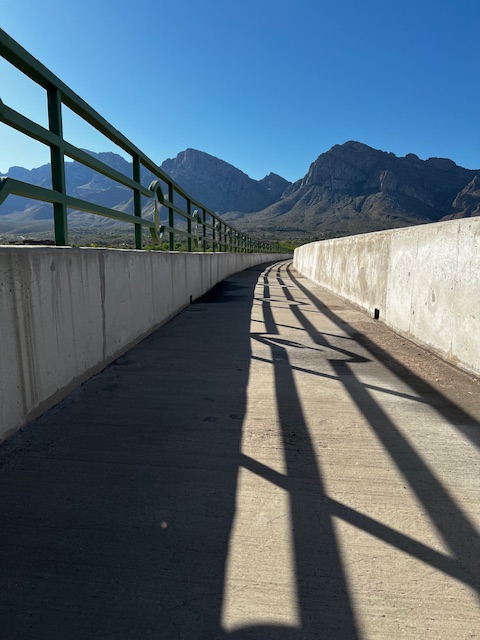
I do all of my running in the Tucson area where our local lizards like to come out and relax on the pavement as the sun comes up. This means that it is pretty common to run up on a lizard that is sunning on the trail. When I get too close to one of these sunning lizards they will sprint away from me. There are a couple of bridges I run across where the trail is blocked on both sides by a ravine on one side and a concrete wall to protect pedestrians from a busy road on the other side.
When a lizard finds itself in one of these bridge paths it can’t run to the sides so it will run straight ahead, down the path, trying to get away from me. Lizards aren’t bred to be long distance runners so they will run 10 or so feet, stop and wait for me to get close again. Once I get close it runs another 10 feet or so. After a few times of this running and stopping the lizard can’t run anymore. It realizes it is trapped with nowhere to escape so it flops on its back and surrenders. The lizard knows it is going to be eaten by a predator that did not give up the chase. As I run past the lizard it flops back on to its feet and walks back the way it came; looking for a place to hide and recover from the trauma it just experienced.
Every time I see a lizard give up after I’ve chased him down a narrow causeway I think about the theory of persistence hunting. Persistence hunting is the idea that our ancient ancestors chased their prey over long distances, waiting for the prey to tire out. Once prey got tired we would catch up to it, kill it, and then take it back to camp for a feast.
One of the theories about why humans can run marathons and farther today is because our deep ancestors evolved this persistence hunting strategy over thousands of years. Today we don’t need to chase a hamburger all afternoon in order to eat it but we do need to exercise after eating that hamburger. Good thing for us, as the theory goes, that we have this deep historical trait in our DNA that allows us to run for hours at a time without stopping.
There is quite a bit of debate about whether our ancestors used persistent hunting strategies. Physically we have a bunch of traits that seem to support distance running: Short toes that don’t break up on repeated impact, hairless bodies that can wick away sweat, the ability to breathe through our mouth and nose at the same time, an upright posture that gives us an advantage in movement over time versus other apes that hunch and have to use their hands for movement.
The debate probably isn’t solvable. But I am a believer in persistence hunting. When I run I see creatures all the time that I think I could probably chase around Arizona and eventually capture if I wanted to do it.
Part 2: Kenyan Runners:
https://www.cnn.com/2019/11/06/africa/kenya-runners-win-marathons-trnd/index.html
Genetics and persistence hunting in running is a complicated thing. As you were listening to me talk about running and thinking about some connection to our deep ancestry there is a good chance you had some thought about Kenyan runners and their dominance of the sport. You have probably heard that the reason Kenyan’s win so many races is because of some deep genetic trait that is unique to Kenyan’s and gives them an advantage that no one can overcome.
There are problems with this theory. The first problem is that marathon and distance running started to become popular in the 1890’s. From 1890 to 1960 there were Kenyan runners. Kenya was part of the British Empire so Kenyan’s could compete in events on British teams. Kenyan runners were not dominant in the first 70 years that people were competing in long distance events. You would think if they had such an overwhelming thousands-of-years-old advantage that it would have shown up right away. But instead the records of Kenyan runners before 1960 is of mediocre and forgettable performances.
For example, in 1920’s Mexico tried to get the Olympics to adopt the 100k as a sanctioned event. Mexico’s logic was that the Tarahumara people from the Chihuahua territory of Mexico had villages that were spread out from each other. People in this region ran all the time to get around and had cultural advantages in running long distances. Mexico reasoned that they could sweep Gold, Silver, and Bronze in an Olympic 100k just by sending the best runners of the Tarahumara people to the Olympics.
If Kenya was so obviously a hotbed of genetically advantaged runners then they would have been at the fore in distance running circles right away. Instead it took over 70 years before Kenya’s dominance emerged.
Before the 1966 games in Jamaica Kenyan runners had been regularly competing in world and British events and had one medal, a bronze in 1958 in a 6-mile race. In 1966 in Jamaica the runners from Kenya took home more medals than any other country. They broke several records and dominated race after race. They have basically dominated distance running ever since.
As far as I can tell what changed was not genetics but location. A town called Iten, in the Rift Valley Region of Kenya was established in the early 1960s and it appears to be the ideal location for long distance running. It is located on the equator but is also at about 8,000 feet of elevation. This global location and height means that it is never too hot and never too cold but also gives runners the advantages of high-altitude training.
In 1966, when runners from this region destroyed all competition in Jamaica it made people notice. People from this region wanted to be like their local heroes and became runners. People who were curious why one little area of Kenya produced so many dominant runners came there and stayed to train. The cycle of runners creating runners continued and now there are training programs, year-round housing, running scientists, The High Altitude Training Center, HATC, is in Iten. The result is that Iten and the surrounding area of the rift valley is where people who want to become world elite level runners to to train.
There are other advantages too. This region of Kenya has seemingly endless miles of hilly red-clay roads. Red clay is substantially more forgiving than running on concrete which allows runners to run more than the rest of us who live in paved cities or have to deal with regular dirt or gravel roads.
Another advantage is the local cuisine. Absent are industrialized garbage foods. Instead the local cuisine is much healthier, more balanced, and overall better for producing lean-runners. So what is the local food of the Rift Valley?
- Cornmeal (called Ugali), green vegetables, milk, beans, and eggs.
- Prep is usually done by boiling or pan frying foods. Very little grease or fats
- Food from farms not factories. There are few stores to buy from. Most food comes from local markets
Finally there is the advantage I mentioned at the start: Competition. If you live in a city of 40,000 people where everyone is trying to be the next great runner then the competition to stand out is going to spike. There are few, if any, other places in the world where the conditions of steel-sharpening-steel are so perfect as to produce people with a specific skill like marathoning.
When I hear people say Kenyans only win marathons because of genetics I think that sounds a little racist. It’s discounting the training, dedication, and effort that goes in to winning and saying they don’t actually deserve what they accomplish. It has a sour-grapes quality to it. As if these runners aren’t that impressive they are just born that way.
With that said I do think it is important to acknowledge that genetics is a part of competing in athletics. When I was 19 I played a lot of sand volleyball. I got pretty good at 2-person volleyball. One of the harsh lessons of 2-person sand volleyball is that at my height, about 5 foot 11 inches tall, my ability to succeed had a ceiling. I could look pretty good in a sand match until my opponents were 6-4. At that height they could easily reach above the net and spike balls down on the ground. Even if I was technically better players at that height would often win because they could physically do something I couldn’t.
In sports there are advantages like this. Some are easy to see, like height. Some are harder to see like innate muscle reaction times. For example genetic analysis has discovered a thing called an ACTN3 muscle fiber which is present in all of us but is abundant in about 3% of the population. If you have this particular muscle fiber in abundance then you are born with an advantage in muscle gain and muscle sustenance that the other 97% of us do not have.
These type of genetics only matter on the margin. Anyone who is physically able can run a marathon. With proper diet and training you can even get in to the top 10% of finishers at a competitive marathon. It is not until you get to those levels that you start to see and feel the difference between you and someone who has innate advantages.
At my peak of running I had the potential to run a 3 hour marathon. I had spent several years on a strict diet, developed a complicated running and exercise routine, and was militant about rest, recovery, and all facets of training and preparation that I could control. I came to running late in my 20’s so I couldn’t make up the lost time but I thought I could train my way in to a sub 3-hour marathon.
At my height of physical conditioning things started to unwind. An ab-muscle injury. Then plantar fasciitis. Then persistent knee pain. One by one things went wrong almost as soon as I hit that three hour threshold. Over the next 10 years I re-worked my foot strikes, experimented with dozens of different shoe types, and changed my diet around. The result is that I can still run and I can still complete marathons in three and a half hours or so. But running was like sand volleyball. I had a ceiling that I could not get past.
In the end I’ve never gotten back to that elite speed. As I near my 50’s I know I never will get back what I did in my early 30’s. but I also am not bitter about it. I run over 200 miles a month without injury and have completed over 35 marathons. While I don’t have the elite 2 hour marathon times I do have stamina over years that few people can brag about and that’s pretty good too.
Part 3: Let’s Talk About Feet, but not in a creepy way
If you watch an elite runner’s legs and feet in slow motion you will notice that the lead foot goes forward in the air and does not strike the ground until the foot is in its back swing of the running motion. As the front foot is going backwards it lands on outside of the toes by the pinky-toe and then rolls inward on to the rest of the toes. the foot increasingly makes contact with the ground until about 70% of the foot is on the ground and then just as the heel is about to touch the surface of the ground the foot vaults up and continues backwards.
After the foot leaves the ground it and the leg it is attached to move in a circular motion backwards going up and up and up until the back of the heel nearly touches the runner’s butt. While all of this is happening the other foot is coming to the ground and repeating the actions I just described.
In slow motion it has a very poetic and eloquent quality to it. Elite runners feet seem to hover just above the ground forever before they touch in a way that is hard to describe. An elite distance runner’s legs collapse and expand with such speed and power that you can’t see most of it at regular speed. It’s only on slo-mo when you can appreciate what they are doing.
At the other end of the spectrum… If you go to a running path near your house and wait for the average-joe runner to come by you will not see the form and grace I just described.. What you will see instead is tiny shuffle steps where the feet barely have a back kick. No one’s heel is going back and clipping them in their posterior at the local trail.
For an average runner the front foot extends out, heel first, desperately looking for the ground. Instead of going out and then starting back in mid-air the leg swings out and the heel collides with the ground. Remember that the heel never touches the ground at all in an elite runner’s stride; but it is the major landing spot that absorbs almost all of the impact on a normal person when they run.
After the heel strikes down the whole foot will flop to the ground all the way to the toes. Then the heel leads the foot’s escape from the ground while the other foot flops awkwardly to the pavement. If you watch an elite runner then switch to this scene you will have sympathy knee pains for the amateur runner you are watching.
We use our heels for braking not accelerating. If you’ve run down a steep hill and started to feel like you were out of control then you know how you try to stop. You lean back and dig in your heels to try to regain control from the momentum of the hill.
When you run a marathon you will take over 20,000 steps during the race. A heel-first runner is going to create 20,000 brake events as they race. Imagine tapping the brakes on your car constantly the whole time you are driving and consider what damage that does to your brakes and to the sanity of everyone in the car with you.
The other notable thing about elite runners vs amateurs is the noise. An elite runner makes almost no sound when they touch the ground. The impact is so minimal and so graceful that it is basically silent. By contrast an amateur runner sounds like a team of shodden horses on a loose brick road. Everything about these contrasts are a reminder that good form will extend the life of your legs for years or decades and you know it just by the sound, or lack thereof, runners make when they hit the ground.
I have spent a decade trying to fix my foot-landing position to be toe-first every time. I have never been able to fully retrain myself to do it. When fatigue sets in I always revert to a heel strike. I have also never been able to get that back stroke of my leg to where my heel goes all the way back and touches my butt. I get to about a 90 degree angle off the ground and my legs will not bend any further.
Even just standing in place and trying to bend my legs back as far as elite runners do is impossible for me. And every year I get older that backwards motion gets harder. I lack the flexibility and pure physical structure to employ the motion they do.
To be clear the genetics of form and explosiveness aren’t a Kenyan thing. I’m from Nebraska and know several runners who are also from there who can run in the mid to low 2 hour range on a marathon. I also know several Nebraskans who run 50 and 100 mile races. They have the form. The genetics to be a great runner are not unique to Kenya; they are everywhere. Few of us have the drive, dedication, and location to go with the genetics to be elite runners. But it can spring up anywhere. Maybe you have it so get out there and start running!
So while I lack the genetics to go past that 10th percentile of runners my running success means to me that just about anyone can be a successful runner.
My main tips for people who want to run a marathon are pretty simple. I believe anyone who is in relatively good health and doesn’t have some underlying condition that prevents them from running can run a marathon within 6 months to a year of training. Here are the steps I recommend people follow to becoming an amateur but competent marathoner:
- Weekly Mileage Matters
- Run on Consecutive Days
- Just Run – Worry About Tactics and schedules later
- Learn to Eat While Running
- Hurt vs Injured: Listen to and Understand Your Body
- Buy a Good Pair of Shoes (and socks)!
- Run Outside
- Sign Up for Races
- Do NOT Worry About Weight, Get Healthy
That’s it. 9 quick rules. Basically to run a marathon you need to be able to consistenly run over 35 miles per week. You need to run on consecutive days because running while fatigued or tired is good experience for when you run a marathon.
A lot of running guides tell you to do hills one day, speed another… I think all that is good but can make it hard for people with busy lives. If you just go out and run an hour or two a day you can run a marathon. Once you have done it once and want to improve then the schedules and tactics become important.
Eating while running is important. You will run out of your body’s store of energy before you get to the end of a marathon. You have to find something you can eat while you run to get you to the finish line. I recommend Clif’s Block Shots but anything that works for you is fine.
If you run 5 or 6 days a week for a year you will do plenty of runs while ‘hurt’. Aches and pains are a normal part of being alive. Knowing when you are hurt vs being actually injured is important because you need to be able to push through ‘hurt’ and you need to avoid running when injured where you could actually permanently damage your body.
Buying a good pair of shoes and socks seems obvious. You are going to put thousands of steps in to training for a marathon. Don’t go cheap on the thing that will support you through those steps. I love Newton running shoes but everyone has different needs and preferences. You should replace shoes diligently about every 250 to 300 miles.
Run outside is great for pushing past limits. A treadmill messes with your mind because the stop button is right there and easy to push. If you go outside and run 3 miles away from your house then you have to run 3 more miles to get home. There is no stop button outside. You will be surprised at how far you can go when you have no choice.
Signing up for races is important because running by yourself on a training run and running in an actual race are totally different experiences. If you are going to run only one marathon in your life then you don’t want to waste that experience on a day where you misunderstand what a race day will do to you. Run a 5k and a 10k before your marathon so you get distances you can easily complete that will help you understand what a starting line is like, what it’s like to navigate other runners, and other things like do you throw up from nerves before the race? There are all sorts of things that happen on race day that you won’t expect until you’ve done it.
That last one is a big deal. Don’t worry about losing weight because exercise is not how you lose weight.
There is a great book called Burn, by Herman Pontzer which makes it pretty clear that it is nearly impossible to lose weight by exercise alone. The basics of this is that people all over the world, whether nomadic or working in an office burn the same amount k/cal per day. It doesn’t matter if you run every day or never do more than walk from the office to the car and back.
Burn is a whole book on the science of this but the very, very short version is this: Let’s say you burn 3,000 k/cal per day. It takes about 500 k/cal’s to just do the minimum of getting your body and brain around for 24 hours. If you burn another 500 k/cal’s doing other things besides just existing then you have 2,000 k/cal’s to work with. If you go for a 10 mile run you may use up a bunch of that excess k/cal’s. If you don’t exercise those k/cal’s away your body will still burn them by hot flashes, nerve firings, or other internal mechanical activities.
So exercise will make you feel better because it uses up the excess k/cal’s our bodies burn no matter what in productive ways. What exercise alone does not do is cause you to lose weight. The only way to lose weight is to get your k/cal intake below your daily average k/cal burn. And that burn rate can’t be substantially increased by exercise unless you are exercising over 12 hours per day.
When I tell people that I run 50 miles or more per week they almost always say: “oh wow, I bet you can eat anything you want and never gain weight!” I usually don’t try to explain them off of this but I do always have a moment where I consider taking them through the information from Burn.
Part 4: His name is Richard Bachman
In the beginning of this episode I mentioned the Pedestrianism craze. When I was about 11 years old I fell in love with the horror genre. The first large books I read were Stephen King novels. One of my favorite things Stephen King produced were a couple of novella sets. One set was released as Stephen King and the other was under his pseudonym, Richard Bachman.
The Stephen King novellas were in a set called “Different Seasons.” The four books were presented as Spring, Summer, Fall, and Winter.
This set of books had “The Body” which was turned in to the movie Stand By Me. It also had the Shawshank Redemption which was made in to a movie of the same name. A third book in this set, Apt Pupil, became a great Anthrax song called Skeletons in the Closet and an episode of Family Guy. It was made in to a movie as well which was a box-office flop of a movie that starred Ian McKellen, Brad Renfro, and David Schwimmer.
The fourth book in Different Seasons was called The Breathing Method. I thought it was dumb when I was a kid. Maybe it’s better than I remember. Regardless it hasn’t been made in to a movie and it seems like it probably never will.
That set of stories led me to King’s other 4 set novella at the time called The Bachman Books. The 4 books in the Bachman books are highlighted by the most famous of them: The Running Man. The movie The Running Man was based on this book and stars Arnold Schwarzzenegger. The movie and the book are almost nothing alike. But it is the one from the Bachman book set that became a movie.
Another Bachman story, Rage, was about a kid who decides to shoot people at school. King wrote this back in 1977 and it became an inspiration for several school shooters in the 1980’s and 90’s. Rage feels like a premonition. King has let the work go out of print and has repeatedly denounced his own work as not worth printing or reading. I liked this story when I was a kid and think it is worth reading and considering for what King saw back then that has become part of our world since.
There is a third of the Bachman Books called Roadwork which isn’t part of this digression so I will note the book is there and keep on moving. I didn’t care for Roadwork then and don’t think it’s a strong work now either.
The fourth book in The Bachman Books is called “The Long Walk.” It is the story I want to talk about in this running episode.
The Long Walk is a story of a dystopian future where a game show is set up where teenage boys start walking in a contest. If they fall below a 4 mile per hour pace a certain number of times they get shot to death by onlooking military. The last survivor of the walk gets a cash prize.
The story takes you through a group of the walkers in the event and each of them dies for various reasons. One gets a cramp, one decides to end it all on purpose, one has a heart attack. Each death is a set piece in the story that is meant to be a critique on our world today through the eyes of these teenager’s deaths in a dystopian future.
Some of the contests you can read about when searching around on the internet for Pedestrianism feel like variations The Long Walk. One contest in England I read about challenged walkers to walk 2,500 miles in 6 days on a closed oval course. They weren’t shot for stopping of course but the contestants had to remain on the track constantly for those six days. Presumably they slept on the track, went to the bathroom on the track, did whatever else they needed to do on the track. The winner was the person who had walked the most miles or reached 2,500 miles first. Walking around in a circle constantly for 6 days sounds like a horror movie to me.
But some people think running 26.2 miles sounds like something from a horror movie as well. I will admit that running for 3 or 4 hours straight comes with a lot of mental challenges. I have often thought about King’s Long Walk story while on a long run or while running a marathon. The main character in the Long Walk starts having delusions towards the end of the story. Not spoil a 40 year old book but the winner can’t even accept his prize because his mind is gone by the end of the walk.
There have been times where I’ve worried I was about to go mad on a run. One thing I will do to try to preserve my sanity and make sure I’m ok is this math problem where you add two numbers then add the sum to the next number in the sequence. 1 + 1 = 2. 2 + 2 = 4. 4 + 3 = 7. 7 + 4 = 11, and so on. My goal is to be able to that to 10. I have convinced myself that doing this means I haven’t gone mad. Or maybe doing that is proof I have already gone mad.
So if running is akin to the premise for a Stephen King horror novel then why do it? Running lowers stress, improves sleep, releases dopamine which battles depression, and reduces your risk of heart disease. For me I think it is worth a little madness to have all those benefits.
 More Important Things
Leave a comment