Quote:
“In a training academy for gladiators who work with wild beasts, a German slave, while preparing for the morning exhibition, withdrew in order to relieve himself, which was the only thing he was allowed to do in private and without the presence of a guard. While so engaged, he seized the stick of wood tipped with a sponge, devoted to the vilest uses, and stuffed it down his throat. Thus, he blocked up his windpipe and choked the breath from his body… What a brave fellow. He surely deserved to be allowed to choose his fate.”
- Seneca the Younger approximately 62 AD
In 2023 there was this online trend where someone would video tape a male in their life responding to a question about if they’ve thought about the Roman Empire today. In these videos the guy would often go off on a rant that he was currently thinking about Rome and also how great it was. Often they would talk about how they wished they lived in Ancient Rome or that today was as great as Rome was back then.
One of the most graphic example of why I wouldn’t want to live in Ancient Rome involves a thing called a Tersorium, or Xylospongium. This would have a been a familiar device to all but the very richest families in Rome and I truly cannot imagine living in a way where I would have to use one.
As a common Roman you likely would not have had plumbing in your home. If you lived somewhere decent then someone in your family would have had to make daily trips to a well or some other location for your household daily needs. This water would be for things like cooking and cleaning. But if you needed to go to the bathroom you would either go in a bucket, called a chamber pot, or you would have to go to a public bath house.
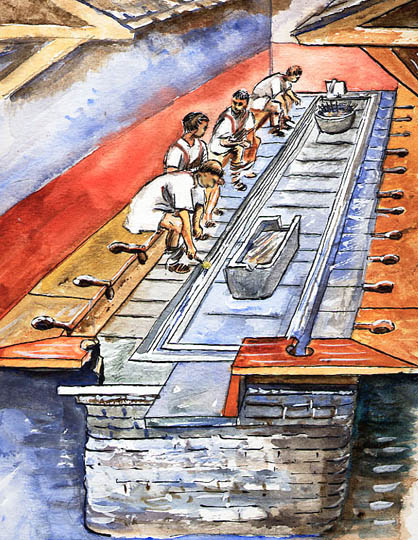
Public bath houses, called foricae, were rooms with rows of open holes that were a couple inches apart. Pooping would often require you to sit cheek to cheek with your fellow Romans with another row of cheek-to-cheek Romans staring at you. All of you would drop your deuces in to a sewer space a few feet below the open holes. Running water from nearby showers would drain and run through this area to wash away the human feces. At least that was how it was supposed to work. Imagine the smell at mid-day on a particularly busy and hot summer day! Yikes
There were other problems with these public toilets.
- Women typically wouldn’t use them because they faced real dangers by going in to one of these bathhouses. Most women opted for the bucket, or chamber pot, option at home for their waste instead. They would keep this pot in their home and then venture out with it to dump in gardens, or wherever, when they needed to be rid of it.
- Public toilets were an open sewage pipe that fed all the way to a waterway. It was common for rats, snakes, spiders, and even things like octopi to come out of these holes at times. Squatting on one came with real risks of being attacked by wild vermin
- Almost as dirty as the rats were the people. Imagine dozens of people pooping next to each other without soap or coverage. These public toilets were a great place to spread lice, typhus, and a host of other nasty diseases. Anything that spreads feces-to-mouth was sure to spread in these places
- Public toilets had a basin room underneath them. Often a few dozen toilets were present in one toilet facility and they all dumped in to the same room below. This room would fill up with methane from the feces. Every now and then fire would shoot out of the toilet seats and burn the people sitting on them. On rare occasions the whole toilet house would explode
If this isn’t enough to make you glad you get to live in the 21st century and don’t ever have to poop like a Roman there is one more detail: The title of this episode is Xylospongium. A Xylospongium was literally a sea-sponge (like Spongebob Squarepants!) that would get fastened to a stick. The sponge end would sit in a little running water feature that pushed clean water through a mini-canal on the floor in front of the toilets.
When you were done pooping in one of these public toilets you would reach out and grab this xylospongium from the water feature and use it to scrub the poop out of your butt. When you were done you would put it back in the water feature for the next person to use.
Sponges would rot and mold quickly unless kept in vinegar, salt-water, or sour wine. It is likely that the sponges in these bath houses were stored in running water features with a vinegar or salt-water compound included. This would have improved the sanitation of them but it is still hard to imagine using the butt-wiper the guy before you just used.
It is not clear how often they were replaced. But I imagine one would get used for a few days at least before a new one would arrive. That means you were likely using the same sponge to clean your butt that hundreds of other people had used. If the guy who used the sponge before you had worms then guess what?: You have worms now too. Congratulations.
I want to be fair here. It is possible that many people had their own sponge that they carried with them for wiping purposes. Maybe the ‘public sponge’ was only for people who couldn’t afford one. This would mean that slaves and the very poor may have used the public sponge while others used the bath house, sat cheek-to-cheek with their poop-neighbors but had their own sponge which they used and then rinsed in the water flow feature. In the best case scenario there were still some people in these bath houses sharing butt-wipe sponges.
While we don’t know a whole lot about these bath house sponges we do know a lot about sponge usage in the Roman world. Some of the finer sponges required skilled divers to go in to deep water to collect them. This type of sponge collection is still done much the same way in the Mediterranean to this day. But a whole range of other sponges can be collected near the shore, some wash up on shore and can just be picked up off of the beach by someone walking by.
The deep sponges were a luxury item but the others were functional for a range of uses by the Ancient Romans. Here are some examples of common uses of sponges in Rome:
- Roman soldiers would stuff sponges in to their helmets to make them fit more comfortably and probably to absorb sweat
- Sponges would be soaked with honey to give to babies as pacifiers
- Women would soak sponges in vinegar or lemon-juice and then use them as a contraceptive
- Sponges would be used for painting on walls, pottery, and other surfaces
- Sponges were so common in Rome that one even makes its way in to the Bible. Mark 15:36 quote “And one ran and filled a sponge full of <sour wine> and put it on a reed, and gave it <to Jesus> to drink…” end quote. This scene occurs right before Mark 15:37 where Jesus dies in The Passion narrative.
Going back to the story of the gladiator that kicked off this episode. The Gladiator was so tired of his existence that he literally shoved a butt-wiping sponge-on-a-stick down his throat to kill himself. If that doesn’t beg you off the idea of wanting to live in Ancient Rome I don’t know what will.
What if you were lucky enough to be one of the elites? Maybe it was better for them? The wealthy of Rome did have private toilets. They did not let their toilets connect to public sewage because they didn’t want rats coming in to their homes. As a result, their toilets were a closed space on their estate grounds. Bathrooms were often on a 2nd floor or elevated some other way to make it easier for their slaves to come in to the space under the toilet and clean it out. Even with regular cleaning their private toilets risked fire and explosion due to methane build up. So, it was much better to be rich. But even then your toilet may still blow up and kill you on a hot day.
DISEASE AFTER ROME:
We know the names of all these scary bugs in our world today: E. Coli, Dysentery, Cholera, Typhoid, Hepatitis A, Salmonella, and so on. All of them have similar means for infecting us. They rely on us to poop in a way where that poop can make it back in to our own mouths. Upon re-entry they infect us and become painful and even deadly to us.
Today Dysentery kills over a million people every year. The other diseases I just mentioned combine to kill about 500,000 more people per year. That’s about 1.5 million people who die every year from the basic problem of not being able to get people’s waste away from their bodies and the food and drink they consume. It’s also a problem of not being able to properly wash your hands in clean water, preferably with soap, in many parts of the world.
It seems a safe bet that diseases like these were prevalent in a city like Rome. Today researchers have gone back and studied the poop remains of Ancient Romans. They’ve found that these types of diseases, not to mention worms, lice, fleas, and ticks, were all present.
But when you read about Ancient Rome there is no mention of diseases like dysentery. Is it possible that a disease that kills a million people world-wide today was not killing it’s fair share of Romans back then? Part of the reason these diseases don’t appear is that the Romans just didn’t know about them. The Romans had no understanding of microbial life. The Romans were obsessed with hygine. They had extensive rules and rituals for dealing with dead people, stillborn babies, for sacrificing or cooking animals, and so on.
Even though I spent quite a bit of time dissing Roman Bathrooms it is also the case the Romans thought of their hygiene strategies as very advanced. They really were way ahead of the societies before, and even after them, with regards to pushing waste away from their cities. They didn’t have the science but they understood that excrement was a vector for disease. Without micro-biology their conception of feces-to-disease was about the large piles that would attract vermin. They assumed the diseases came from rats, maggots, lice, fleas, and other pestilence creatures. No one, not even the Romans, would understand this for almost 2,000 years.
The first plague that I can find a lot details about in Roman history happens late in the Empire, around 165 AD. That plague appears to be small pox and it killed around 5 million Romans in a couple year period.
It’s possible that diseases like dysentery and cholera were so common in Rome that people didn’t even think it was worth documenting them. The life expectancy of a common Roman in the first century was about 25 years. It wasn’t like people were living long lives where dysentery deaths were some shocking outlier. It may be that someone pooping or vomiting themselves to death was such a normal part of life that it wasn’t worth keeping records about it when it happened.
After Rome the Medieval Period of Europe is infamous for its filth. They forget the skills of Roman engineering and the prevalence of disease in European cities goes up. Today if you know only a little about Medieval Europe then one thing you probably know is that it was full of plagues and disease.
There is a series of history books by Susan Wise Bauer that I think make for a good starter set to understanding world history. Bauer’s books don’t go in to extensive depth on any particular moment. Instead each book is massive and covers multiple centuries of history all over the globe in a sort of headline-plus-first-two-paragraphs sort of way. It’s enough to get a picture of what was going on but not enough that you are an expert on any topic she covers.
In her History of the Medieval World book there is a stretch that covers the 1100’s to about 1400 where it seems like nearly every region of Western Europe is continually up-for-grabs among 3 or 4 descendants of the last king. 5 minutes after a king dies his sons barely wait until he’s in the ground and then go to war over the lands he left to them.
These would-be kings all have great names. Charles the Fat, William the Bald, Gregory the Blind. It’s a far fall from Charlemagne, or Charles the Great. And it is a period that if all you know about are the names of the kings you get a good idea that it was a rough go for all in those regions.
Anyway, the sons of the recently dead king would go to battle. The winner would get to be king. The losers would typically go one of three ways. Option 1 is they are killed while fighting to be king. Option 2 is they join a monastery after being defeated. Or option 3 is they could go on the run.
Becoming a monk or priest could spare your life for a while but most of the time the losers who chose this path would end up dead by poison a few weeks or months after the new king took the throne. It was not a good strategy for the new king to have a logical contender for the throne hanging around out there, not even in a monastery. People who don’t like the king’s decisions may start to get ideas; and those ideas might involve bringing this person out of retirement in the monastery as an option for the present-king they no longer like.
The third path for the loser if they were not killed or trying to hang on in a monastery was to go on the run. Maybe this loser could run to safety somewhere that doesn’t like the new king. Maybe a neighboring kingdom that has ambitions to attack the new king would see this as an opportunity. A viable puppet king may be enough for them to go to war with the new king and bring this loser along for the ride.
The problem with the run-for-it plan was that most nobles had lived a life of luxury in an age of filth and disease. A common end to this path was that they would go out in to the normal world and almost immediately drop dead from some horrible disease before they could even get to the nearest neighbor. Bauer’s book on medieval history isn’t trying to make a point about disease but because it covers events in a headline format so you get this rapid fire story of would-be-kings dying one after another from commoner’s diseases five minutes after they leave the safe and sanitary of their castles.
POLIO
One disease that travels from human feces to human mouths and then wreaks havoc on us that I did not mention is Polio. In the US cases of polio first spiked around 1916 and then receded. Starting in the 1930’s cases started climbing again. 1952 was the peak year when there were over 57,000 cases. The only reason 1952 was the peak year was because it is also the year that Jonas Salk found a vaccine for Polio. By the 1960’s case rates had dropped to less than 10 per year. Worldwide Polio was nearly eradicated. It is a case where vaccines and improving waste removal have cured our species of a very scary disease.
One of the scariest things I can imagine is coming down with paralytic polio. Having your arms and legs wither away, having internal organs weaken over time to the point where you can’t live without machines. At least dysentery has the decency to kill you in a matter of hours. Polio attacks you for years. It makes you miserable for as long as decades and then kills you.
If you google image search “polio ward” you will see these terrifying images of rooms full of people on these crazy ventilator systems. They look like a nightmare from an HR Geiger drawing. I feel extremely lucky to live in an age where science solved this problem completely.
From 2000 to 2019 there was one reported case of polio in the United States. Officially the disease has been eradicated in the US since 1979. But in 2022 a case of paralytic polio occurred in New York state. Waste water exams from New York confirm that there is an increasing level of polio present in human matter. It is not known how many cases of polio there actually are but since most polio cases have little to no symptoms we can assume that for every one paralytic case there are up to 2,000 cases that go unreported. It is possible that we have gone from 1 case in 20 years to 2,000 or so cases active now.
For over 4,000 years we have been trying to win the battle with these types of diseases, In the 2nd half of the 20th century, for the first time in our history, it seemed we might be about to win the fight. But in the 21st century we seem to collectively choosing to reject the progress and return to our history of disease. Rejecting vaccines is the first step in us willingly decide to go back to a time of death and disease.
But I have a hard time imagining people tearing out their plumbing for political points. As crazy as things seem sometimes in our current political world I just can’t believe people would go back to using outhouses or buckets instead of flushing toilets. One thing I know for sure is that I would not vote for any politician who encourages me to stop using toilet paper in favor of using a communal sea sponge on a stick. That feels like a non-controversial line to put out there that I’m not willing to cross. But maybe that’s just me. I’m also not willing to go with the people who think bringing back Polio is a good idea, so what do I know?
Additional Reading: The Other Dark Matter by Lina Zeldovich
I’m the kind of person who reads two or three books per month. That means that in the past 20 years or so I’ve read about 600 books; mostly about history and philosophy. There are some very obvious books that anyone who likes history, politics, and philosophy will read. Hannah Arendt’s Origins of Totalitarianism, for example.
After a while, when you have read a certain amount of history books, you find that you’ve read a book or three about ancient Rome, another bunch of books about medieval Europe, and you’ve read all you care to about America’s Founders. You get to this point where you start to hate the idea of reading another book about Thomas Jefferson or Julius Caesar or whatever. It is not that some new book about those guys won’t have something new for you. It’s just that they don’t have enough new to justify retracing those steps to get to what is new.
One way to keep history interesting is to look for quirky books. Books that look at things from an odd or unseemly point of view. Mary Roach is a great example of this. She has books like Bonk (a book about science and sex) and Stiff (a book about what happens to corpses) which give you a perspective that isn’t the way you’ve probably thought about things before. It helps that Roach is funny and doesn’t take herself too seriously. She keeps history and social topics fun. You probably didn’t think you wanted to read a whole book on the business of corpses but her book on that makes you glad you read it once you have.
Thinking about how, and where, people have pooped throughout history isn’t something you would normally consider to be a fun read. But the sheer practicalilty of what to do with a million people’s poop every day, day after day, is pretty fascinating. Where did a million pounds of ancient Minoan poop go every day?
The Romans were a society of Engineers so they built structures and waterways and aqueducts to deal with their poop. They were also a society of slave owners. So they hired slaves to carry the waste away. After Western Rome fell, Medieval Europe forgot the Engineering and went back to buckets and forcing people to go to a nearby river to poop.
But walking to the river is far. Many people just dumped their poop buckets out of a window on to the streets below. This was such an issue that every decent-sized city in Europe had laws about dumping waste. This is a reminder of the adage: you don’t need a law to prevent something that isn’t happening.
Even in to 20th century America these kinds of problems persisted. Philadelphia was one of the hardest hit cities in the world by the Spanish Flu in 1918-1919. One issue that Philadelphia faced was that the cities plumbing was terrible and large sections of the city basically had human waste covering the streets. Sewage would back up and flow out of gutters. Political corruption and an overall unwillingness to revitalize the infrastructure eventually caught up with Philly to the tune of 10s of thousands of dead from Spanish flu. If you live with human waste around you will eventually get a pandemic.
America’s plumbin revolution took place in the 1930’s. The 1930’s is also when toilet paper became standard use for the majority of Americans. The Farmer’s Alamanac had a pre-drilled hole in it that was for the purpose of making it easy to hang on an outhouse wall. Its pages were a popular stand-in for toilet paper in the 1800’s and early 1900’s.
The Other Dark Matter isn’t primarily a history of pooping. It’s more like an expert take on how modern excrement may be a useful resource in battling climate change and improving life going forward. But the opening part of the book is history and it is fun to learn how people going back 4000 years have dealt with their own poop. As we continue to grow our world population thinking about where all our waste goes will continue to be an ever-increasing concern and The Other Dark Matter is a good intro book for thinking about this problem and its solutions.
 More Important Things
Leave a comment